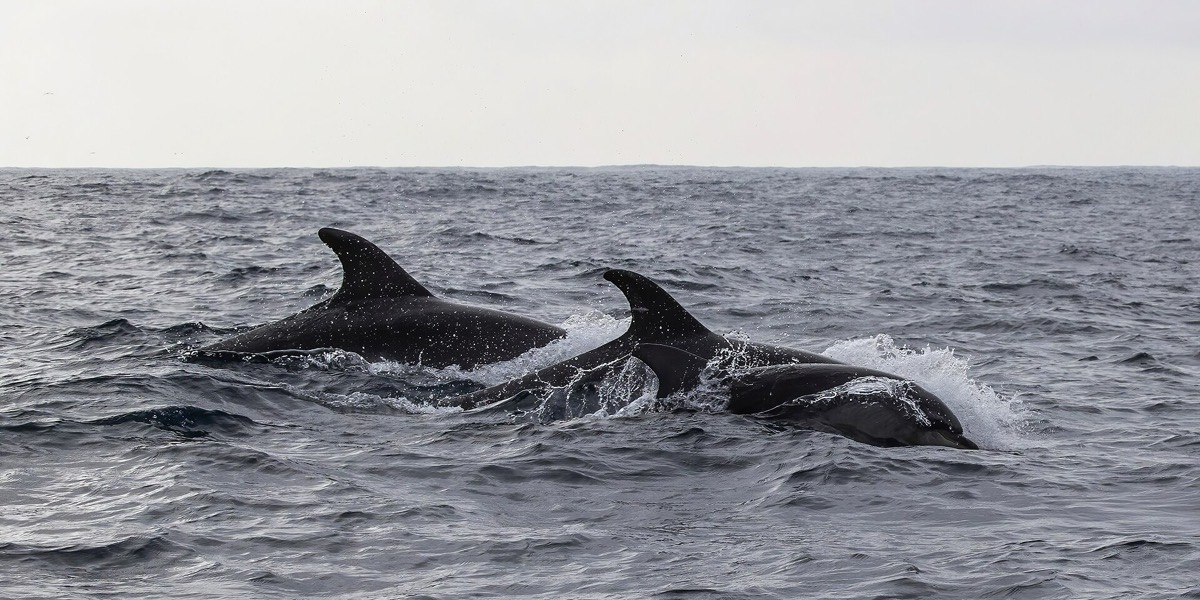
At Laguna in southern Brazil, some resident bottlenose dolphins work with beach-casting fishermen, driving fish toward the nets and cueing the throw. Others in the same population never do it. Both groups use the same lagoon, so sharing water is not the question. Daura-Jorge and colleagues used to map who associates with whom. Does the hunting tactic show up in the social network?
It splits the network. were higher among cooperative dolphins than among non-cooperative ones, and higher than between animals from different foraging classes. The network divided into three , clustering individuals by whether they share the tactic. Space use was not enough to explain the partitioning, so the division is behavioral rather than geographic. The overall structure is still the loose arrangement typical of the species.
Localized foraging traditions turn up in isolated populations of many species. At Laguna in southern Brazil, a subset of the resident bottlenose dolphins uses one of the stranger ones. They cooperate with local beach-casting fishermen, driving fish shoreward and signalling the moment to cast.
The rest of the population does not. That makes Laguna a natural experiment, with two foraging classes sharing one lagoon, and raises the question of whether the difference reaches beyond hunting into who associates with whom.
Daura-Jorge and colleagues answered it with individual photo-identification data. The population overall is a fission-fusion system with few non-random associations, which is typical for the species. Against that background, association values came out higher among cooperative dolphins than among non-cooperative dolphins or between the two classes.
The network itself divided into three modules, clustering individuals who shared or lacked the tactic. Space-use patterns were not sufficient to explain the partitioning, which points at a behavioral factor rather than a geographic one. Foraging behavior may be driving social structure, and the closer association between the cooperating animals would in turn make it easier for the tactic to be learned from other dolphins.
wat. The dolphins who work with the fishermen keep company with each other, in the same lagoon as the ones who do not.
wat wat
If animals that share a tactic also spend their time together, then the social structure is the channel the tactic travels along, which is how a learned behavior survives a generation.
How do we know?
Daura-Jorge and colleagues used individual photo-identification data from the Laguna population to measure association strength between dolphins and test whether cooperative and non-cooperative animals were socially segregated.
What is still unknown
Association patterns from photo-identification show who is seen with whom, not who learned what from whom. The direction of cause between foraging tactic and social clustering is not resolved here.
Learn something?
Where to next
 How does a group of male elephants decide it is time to leave?society
 Does a dolphin have anything like a name?dolphins
 Can living beside a sick animal change the way you smell?society