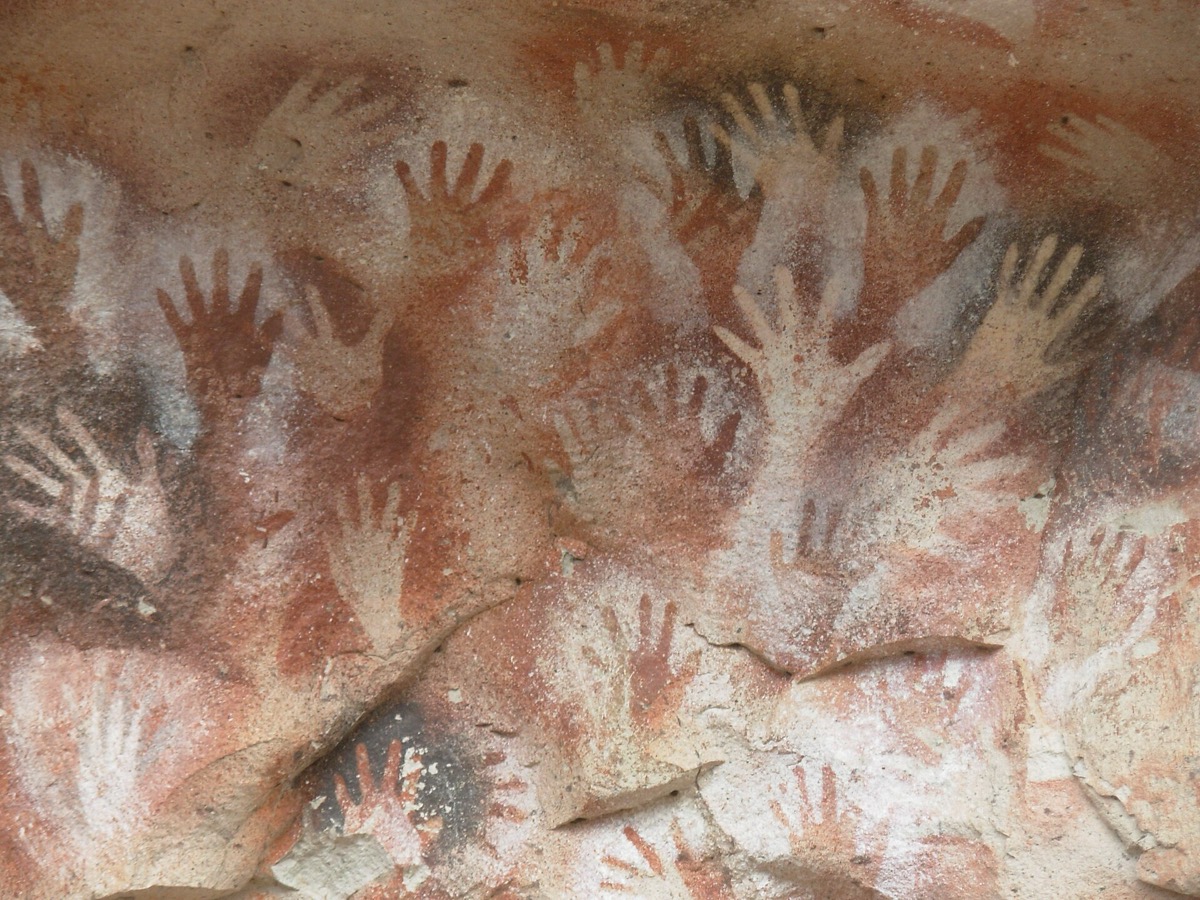
Cueva de las Manos in Argentina takes its name from the stencilled outlines of human hands that screen its entrance. A single hand is a signature; a wall of them is something else. The site also holds and hunting scenes, and the art was not made in one visit. UNESCO’s World Heritage listing describes what the accumulation actually looks like, and how long it took.
It accumulated across a very long sequence. The entrance is screened by a rock wall covered by many . Within the rock shelter there are five concentrations of rock art, with later figures and motifs often on those from earlier periods. The artistic sequence includes three main stylistic groups and began as early as the tenth millennium before present, and the site was last inhabited around the year 700.
Cueva de las Manos, Río Pinturas contains an exceptional assemblage of cave art, set in a landscape where the river runs through a deep canyon. It takes its name, Cave of the Hands, from the stencilled outlines of human hands, and the entrance to the cave is screened by a rock wall covered by many of them.
The hands are not the only subject. There are many depictions of animals, including guanacos still commonly found in the region, as well as hunting scenes that show animals and human figures interacting in a dynamic and naturalistic manner. The paintings were executed with natural : iron oxides for red and purple, kaolin for white, natrojarosite for yellow and manganese oxide for black, ground and mixed with a binder.
The structure of the site is where the accumulation becomes visible. Within the rock shelter there are five concentrations of rock art, and later figures and motifs are often superimposed upon those from earlier periods. The artistic sequence includes three main stylistic groups and began as early as the tenth millennium before present. Archaeological investigation shows the site was last inhabited around the year 700.
UNESCO considers it one of the most important sites of the earliest hunter-gatherer groups in South America during the Early Holocene that still maintains a good state of preservation. The people responsible may have been ancestors of the historic hunter-gatherer communities of Patagonia. Two cautions belong with that. This is a heritage listing rather than a research paper. Its own text gives different date ranges for the art in different sections, which is a reason to treat any single figure loosely.
wat. Generations kept coming back to the same Patagonian wall and adding their hands on top of the hands already there.
wat wat
Superimposition is the detail that turns a wall into a record. Later hands and figures placed over earlier ones means people kept returning to the same surface over thousands of years, adding to what was already there.
How do we know?
The UNESCO World Heritage listing for Cueva de las Manos, Río Pinturas describes the hand stencils, the concentrations of rock art, the stylistic sequence, the mineral pigments used and the archaeological dating of occupation.
What is still unknown
A heritage listing rather than a research publication, and its own text gives inconsistent date ranges for the art in different sections. The identification of the painters with the ancestors of historic Patagonian peoples is given as a possibility.
Learn something?
Where to next
 Do two minutes in front of art online change how you feel?art
 Can a museum visit improve how you feel, or is it just an outing?art
 What does an explanation beside a painting do to the way we look?art