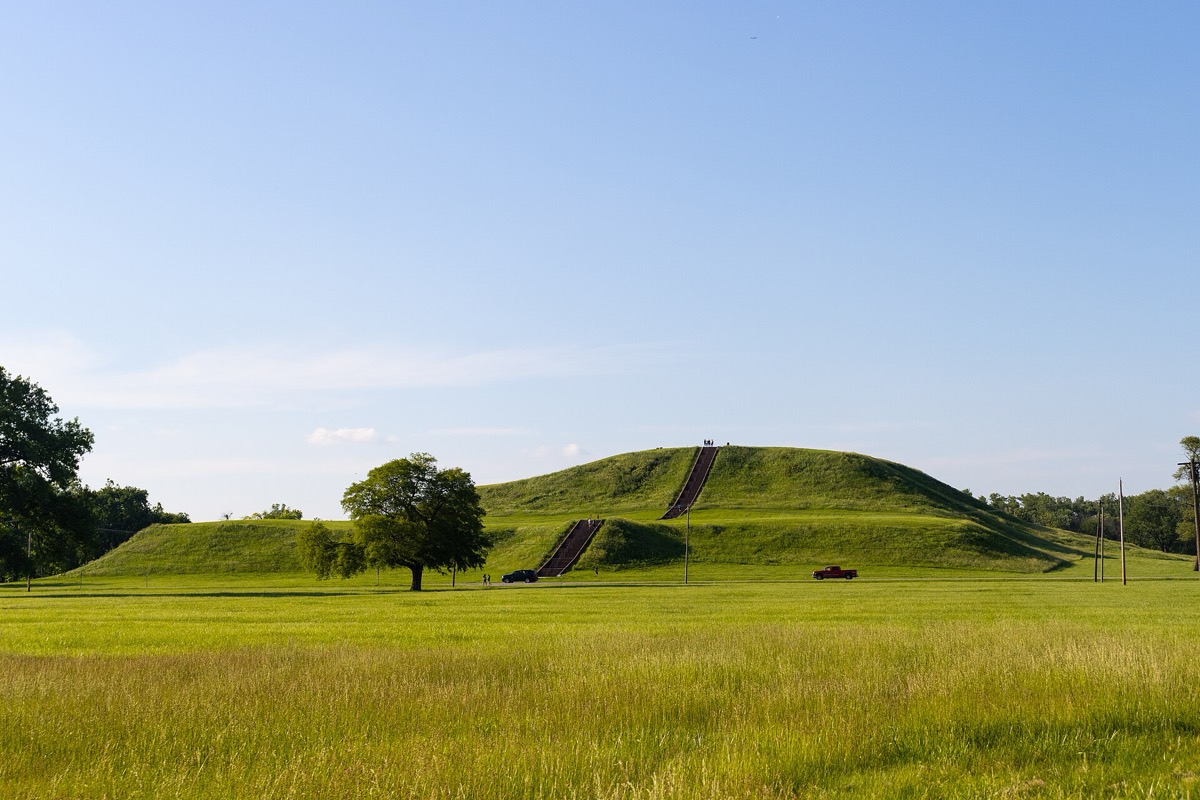
Cahokia was the largest population center in pre-Columbian North America, with enormous where St. Louis stands today. Around 1400 it emptied, and ever since it has been told as a civilization that vanished. Then researchers measured chemical traces of human beings in the bed of a nearby lake, layer by layer. What did those show?
The area did not stay empty. The low point in population does arrive around 1400, and by about 1500 it recovers, and around 1650 it reaches a peak. Only afterwards, around 1700, does it fall again. The recovery coincides with an environmental shift that favored growing maize and hunting bison, exactly the way of life of . The decline that follows lands on an eighteenth century crowded with wars, epidemics and movements of people.
The scale of Cahokia is hard to hold in mind. At its height, in the eleventh and twelfth centuries, thousands of people lived there and around it, more than in the London of the same period. It was the great center of the world, with a large plaza at its heart and more than a hundred earthen mounds around it, the largest rising as high as a ten-story building. All of it was built with no metal, no wheel and no draft animal.
Then, across about a century, it emptied. The explanations offered include drought, floods, deforestation, a shortage of wood, and internal political tensions. Earlier work, from 2019, found a match in time between the fall in population and signs of flooding and a change in rainfall. None of the explanations rules out the others.
The question this work asks is different: what happened next. Archaeology struggles to answer it, because small groups that build no mounds leave almost no layer anyone can excavate. solve exactly that problem: they reach the lake from people who built nothing, so they see a population that classical archaeology misses.
The picture that emerges is a wave rather than a line. A low around 1400, a rise from about 1500, a peak around 1650, and a second decline around 1700. The rise coincides with a period whose conditions suited maize and bison, and the decline lands on a century well documented in written sources, with wars, epidemics and the movement of whole groups.
The difference is not only in the facts but in what can be said with them. “A civilization that vanished” is a story that ends, and so it also licenses a jump from the mounds to European settlement with nothing in between. A curve showing a population that returns, peaks and is then struck in a documented century tells something else entirely: not disappearance, but continuation.
wat. Stanols in a lake bed show the Cahokia area was repopulated about a century after it emptied, reaching a new peak around 1650.
wat wat
The story of a vanished civilization is convenient, and it also erases continuity. If the area was repopulated and flourished for generations, what happened afterwards is not a mysterious disappearance but documented eighteenth-century history.
How do we know?
A demographic reconstruction from fecal stanols in the bed of Horseshoe Lake in Illinois, together with archaeological finds, historical sources and environmental data. Published in 2020 in American Antiquity.
What is still unknown
A stanol curve is an estimate rather than a census: it measures how much material reached the lake, and factors such as flooding or a change in flow affect it. It also describes one drainage basin rather than the whole Cahokia region. The link between the recovery and the environmental conditions is a match in time, not proof that one caused the other.
Learn something?
Where to next
 Where do the oldest people in the world live? Where there are no birth certificatesdemography
 Did Vikings wear horned helmets?archaeology
 What did a meal from the past leave between the teeth?archaeology