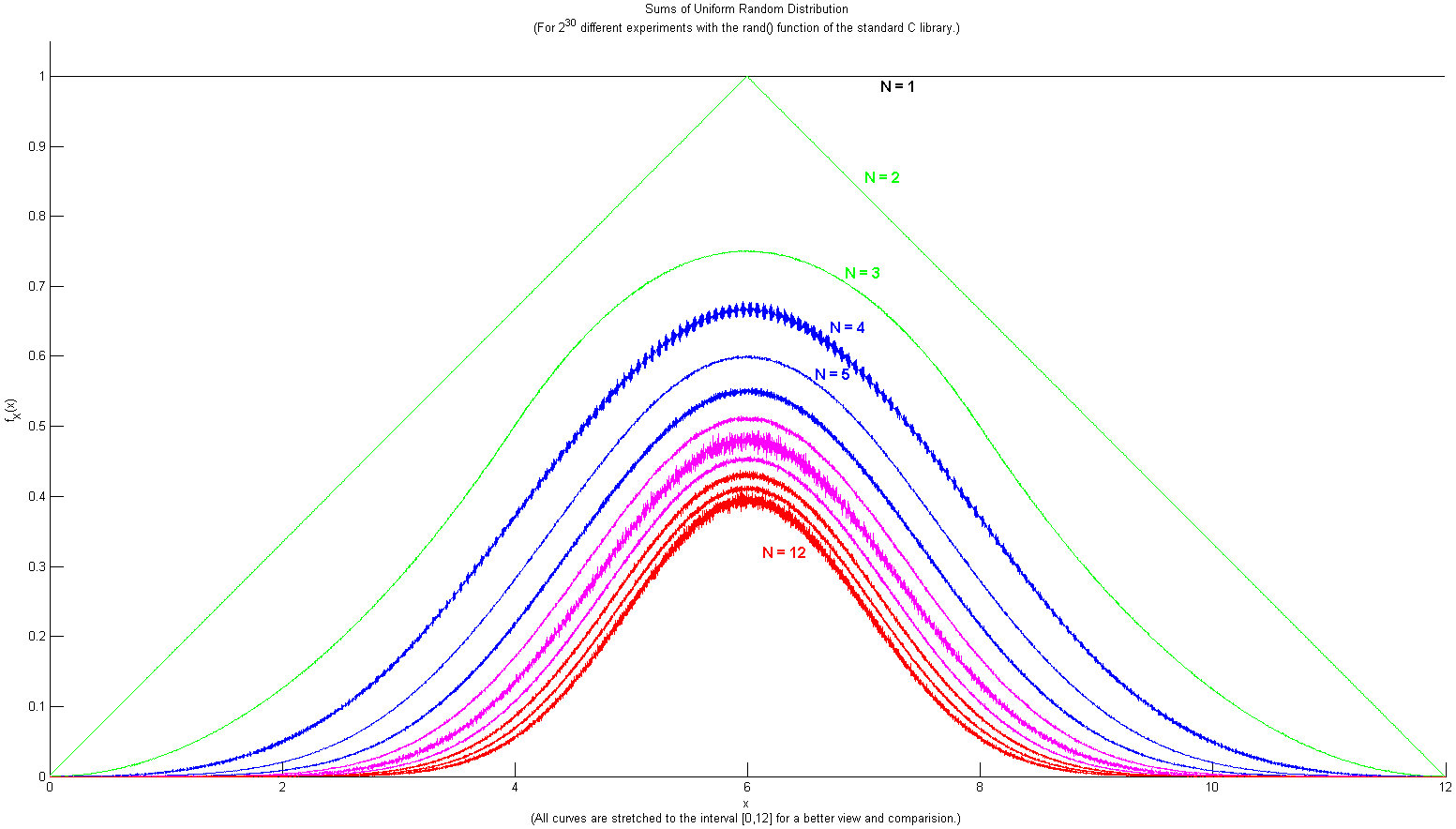
Heights, measurement errors and exam marks come from completely unrelated processes, and all of them pile up into the same bell shape. That cannot be coincidence, and it is not a fact about any of those subjects. It is a theorem about what happens when quantities are added together.
Because sums converge on it. The central limit theorem states that the of with approaches a normal distribution. Each variate may have an arbitrary probability distribution of its own; what matters is that they are independent and that their variances are finite.
The central limit theorem states that the normalized sum of independent random variates with finite variances approaches a normal distribution. Take a set of independent random variates, each with an arbitrary probability distribution, its own mean and a finite variance.
The normal form variate built from them has a limiting cumulative distribution function that approaches a normal distribution. Under additional conditions on the distribution of the addend, the probability density itself is also normal.
The individual shapes do not matter. That is the whole force of the theorem: heights, errors and marks arrive from unrelated processes, and the sums behave the same way regardless.
Proofs come in several lengths. Kallenberg gives one in six lines, while the elementary but more cumbersome route works through the , expands, and recognizes the result as the Fourier transform of a Gaussian function.
wat. Add enough independent things together and the bell appears, whatever they were.
wat wat
It explains why a single curve describes so much without anyone arranging for it.
How do we know?
Wolfram MathWorld states the theorem and its conditions, and gives both a short proof and an elementary one working through the inverse Fourier transform.
What is still unknown
The conditions are real: independence and finite variance. Distributions without finite variance do not obey it.
Learn something?
Where to next
 Can the first digit of a number give away a fraud?statistics
 Can every department admit women at a higher rate and the university still not?statistics
 What happened when the Dunning-Kruger effect was run on random data?statistics