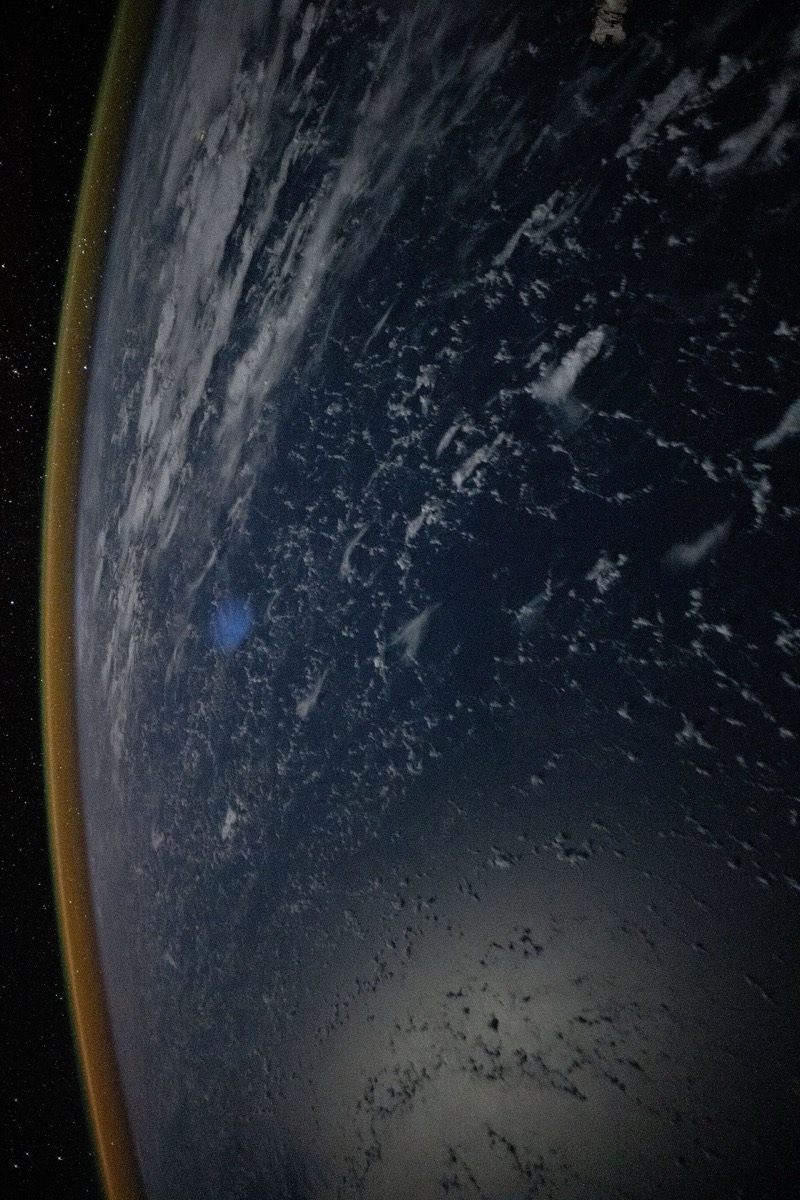
Continuously. is the quasi-steady radiant emission from the upper atmosphere over middle and low latitudes. The point of the definition is the contrast. Auroras are sporadic and happen over high latitudes, while airglow is always there. The glossary even lists permanent aurora among its older names.
The mechanism is chemistry rather than bombardment. Airglow is a photochemical luminescence, arising from chemical reactions in the upper atmosphere that leave molecules and atoms in excited states, from which they radiate at well-defined wavelengths. Emissions from molecular oxygen, atomic oxygen, sodium and the are especially prominent.
Airglow is the quasi-steady radiant emission from the upper atmosphere over middle and low latitudes, and the definition is built around a contrast. It is to be distinguished from the sporadic emission of auroras, which occur over high latitudes. One is an event and the other is a condition, which is why airglow was once called permanent aurora.
Its other names collect the ways people have tried to describe something with no visible cause: light-of-the-night-sky, night-sky light, night-sky luminescence. The glow is faint enough that most observers never consciously notice it, and steady enough that it sets a floor on how dark a clear night sky can be.
The mechanism is chemical rather than electrical. Airglow is a photochemical luminescence, or , arising from chemical reactions in the upper atmosphere. Many of those reactions leave molecules and atoms in excited states, from which they can radiate at certain well-defined wavelengths. Emissions from molecular oxygen, atomic oxygen, sodium and the hydroxyl radical are especially prominent.
That last detail is what turns a curiosity into a tool. Because each species emits at particular wavelengths, the spectrum of the glow reports which chemistry is running and in what state. Measurements of airglow intensity by have provided a great deal of information about upper-atmospheric dynamics and chemistry. One caution: this is a glossary definition, so it names the mechanism and the emitters without going into the individual reactions.
wat. The sky is never fully dark; the air itself is glowing faintly.
wat wat
Those well-defined wavelengths are a free instrument. Measuring airglow intensity by spectrometric techniques has provided a great deal of information about upper-atmospheric dynamics and chemistry.
How do we know?
The American Meteorological Society’s Glossary of Meteorology defines airglow against auroral emission, names the mechanism, lists the species whose emissions dominate, and notes what spectrometric measurement of its intensity has yielded.
What is still unknown
A glossary entry, which defines and lists rather than explaining the individual reactions. It gives no intensities, altitudes or seasonal behavior, so it establishes what airglow is and not how much of it there is.
Learn something?
Where to next
 Has starlight ever been caught building a molecule elsewhere?chemistry
 What does carbon dioxide do once the ocean absorbs it?chemistry
 Is the ozone hole actually closing?atmosphere