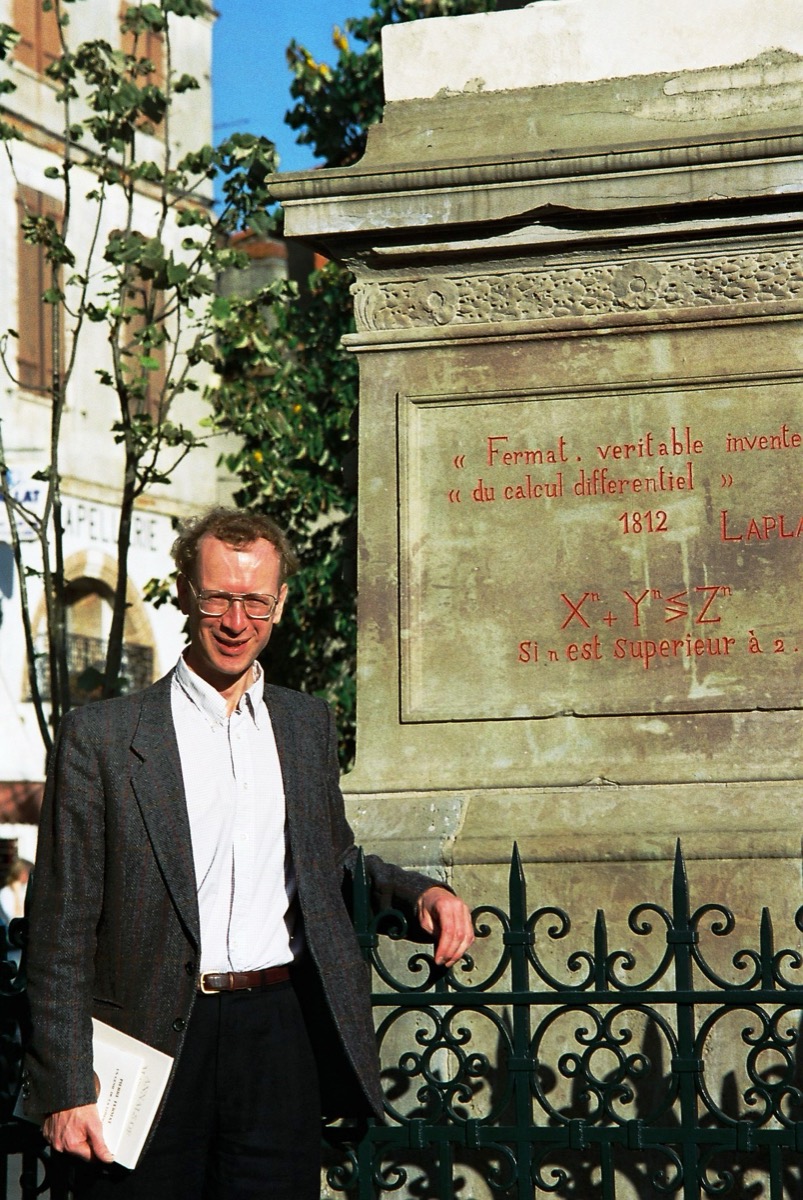
On 23 June 1993, in the third of three lectures at the Isaac Newton Institute in Cambridge, Andrew Wiles wrote Fermat’s Last Theorem on the blackboard, said he would stop there, and sat down. The announcement was the famous part. The next eighteen months were not.
A hole opened in it, and he withdrew the claim. That December, Wiles stated that several problems had emerged during review. Most were resolved, and one remained: the precise upper bound for the in a particular case was not complete. He believed he could finish it soon, and it took another year and a collaborator.
The final chapter began in 1955, when Yutaka Taniyama asked questions about , work nobody then connected to Fermat. Weil and Shimura developed those into the conjecture, and in 1986 Frey showed Fermat’s Last Theorem was tied to it, and so to fundamental properties of space.
Wiles gave three lectures in Cambridge in June 1993. In the last one, on Wednesday 23 June at around half past ten in the morning, he announced his proof as a corollary to his main results. He wrote the theorem on the blackboard, said he would stop there, and sat down.
Then review began. In December that year Wiles spoke publicly: several problems had emerged, most resolved, and the precise upper bound for the Selmer group in the semisquare case was still missing, so he essentially withdrew the claim. Faltings and Weil both said in print that it was as announced.
The repair took another year and a collaborator. Wiles worked with Richard Taylor through 1994 and abandoned the approach using Flach’s methods, then failed with a new one. He addressed the International Congress in August no nearer a solution. He agreed to one last attempt at extending Flach’s method, mainly to prove to Taylor that it could not work, and about two weeks in, it did.
wat. Wiles announced the proof in June 1993 and withdrew it that December.
wat wat
The most famous proof of the century was wrong for a year and a half, and the story is usually told without that part.
How do we know?
The MacTutor account quotes Wiles’s own December 1993 statement, the published comments of Faltings and Weil, and the sequence of attempts with Richard Taylor that followed.
What is still unknown
This is a history of the episode rather than the mathematics, and the technical statements are quoted rather than explained.
Learn something?
Where to next
 How do you prove the primes never run out?proof
 Did Alan Turing really prove the halting problem attributed to him?proof
 Why is there always one point in the coffee that did not move?proof