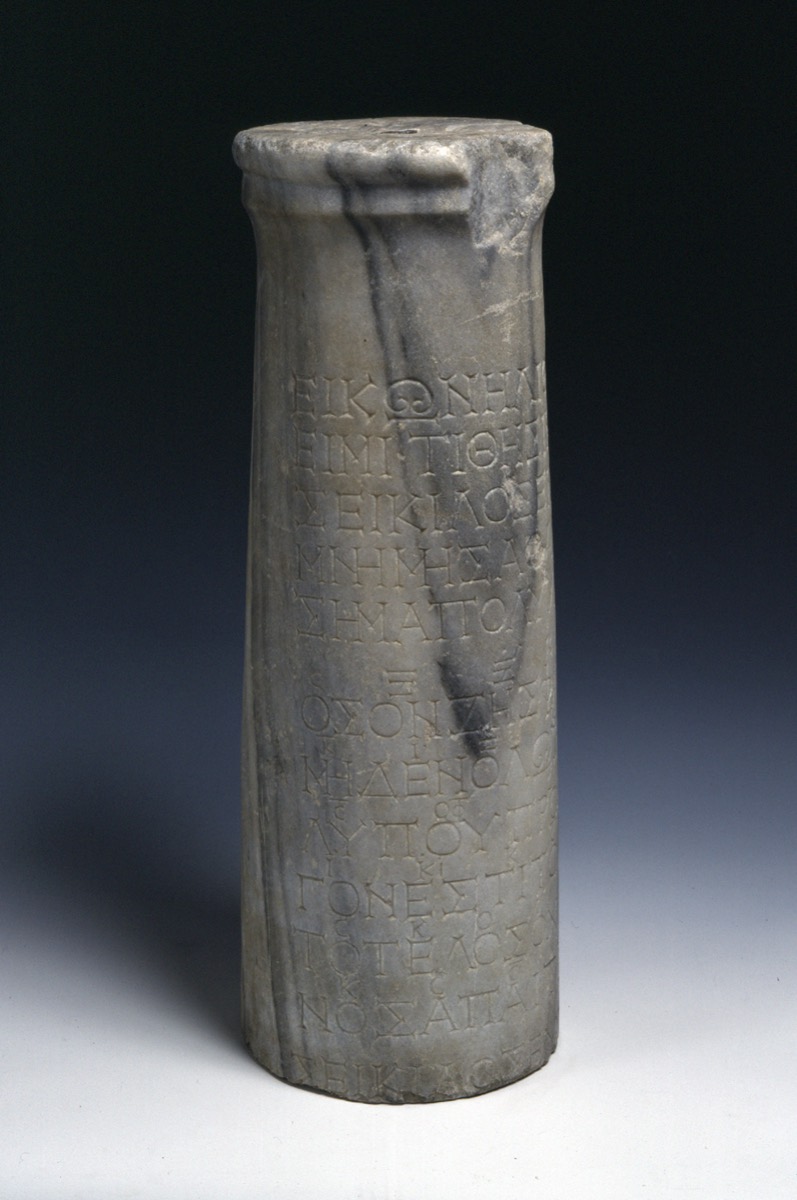
Enough of it to reconstruct how the melodies modulate. Lynch brings together evidence preserved by , Aristides Quintilianus, Ptolemy, Porphyry and the Greek musical handbooks in a single framework. A reconstruction of the Classical , she shows, is confirmed by the melodies recorded in the surviving .
Two bodies of evidence have to be made to agree. One is the technical writing on Greek harmonic theory, which survives in quantity. The other is the small set of documents carrying actual notation. Lynch’s claim is that her articles offer the first comprehensive account of how notation keys are used in those documents that is fully consistent with both, and with literary testimony about the New Musicians.
A surprising amount of ancient Greek music theory survives, and a very small amount of ancient Greek music. The theory comes down through Aristoxenus, Aristides Quintilianus, Ptolemy, Porphyry and the Greek musical handbooks. The music comes down as notation on a handful of papyri and inscriptions. Reconciling the two is the problem.
Lynch brings that evidence together in a unified framework, and shows that the reconstruction of the Classical modulation system she offered in earlier work is confirmed by the melodies recorded in the Greek musical documents. The claim is specific. Taken jointly, this article and its sequels offer the first comprehensive account of the use of notation keys in those documents. It is fully consistent with the extant technical evidence on harmonic theory, and with literary testimonies about the innovations of the New Musicians.
The work rests on a new tool. The theoretical analyses rest on a newly developed database collecting the documents of ancient Greek music. That makes it possible to test a proposed system against every surviving score rather than a chosen example.
The companion article shows what that buys. It offers practical analyses and new modern transcriptions of the Ashmolean Papyri and of Athenaeus’ Paean, scores reflecting the modulation system of the and its characteristic use of exharmonic and chromatic notes. Those seemingly exharmonic notes turn out to correspond to chromatic bends, kampaí, which distorted the central pillars of the notation system. One caution: this is the first of a sequence, with the Imperial-period evidence held for later papers.
wat. The notes survived; working out which key they were written in took two thousand years.
wat wat
Reading the signs is not the hard part. Knowing which key they refer to is, and that is the difference between transcribing a score and knowing what it sounded like.
How do we know?
The analyses rest on a newly developed database of the surviving documents of ancient Greek music, used to test a reconstruction of the Classical modulation system against the notation actually preserved in them.
What is still unknown
The first of a sequence of articles, with the Imperial-period evidence deferred to later papers, and it rests on a reconstruction proposed by the same author in earlier work. Consistency with the surviving evidence is a strong test and not a proof.
Learn something?
Where to next
 Can an audience in a hall really hear a Stradivarius?music
 Does a Mozart sonata really reduce epileptic seizures?music
 Why is a wholly predictable song boring, and a wholly surprising one exhausting?music