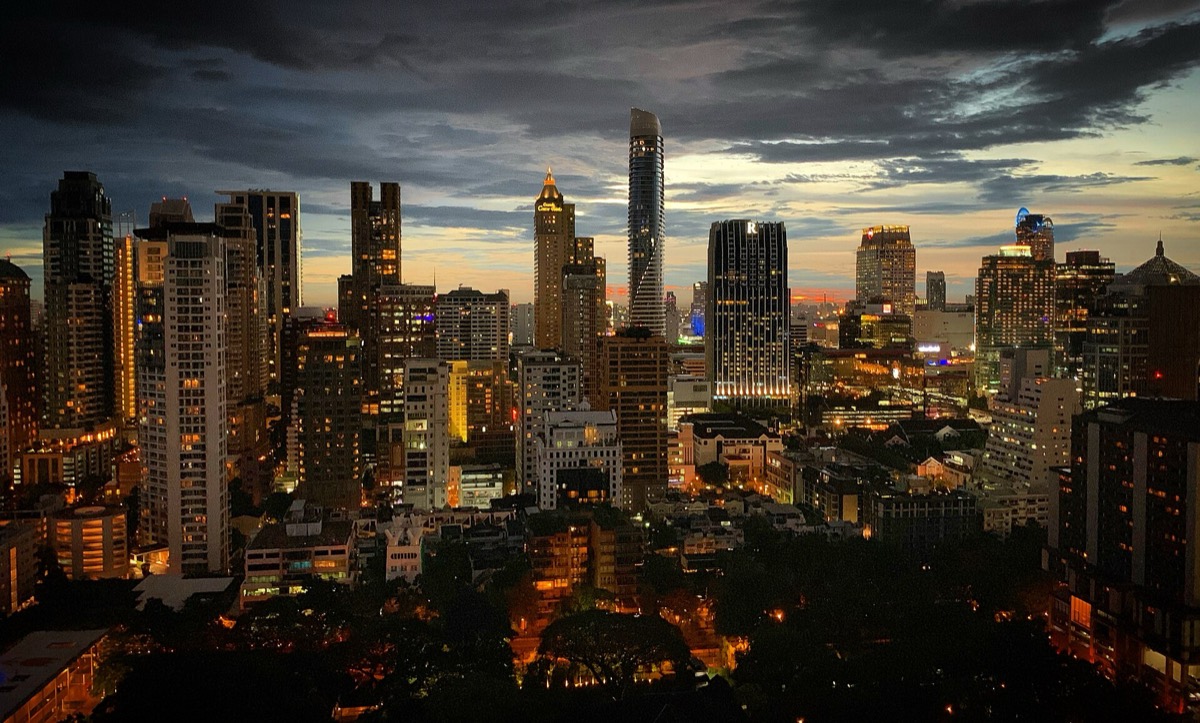
Buildings, roads and other infrastructure absorb and re-emit the sun’s heat more than forests and water do. Concentrate them, cut the greenery, and a city becomes an island of higher temperature than the land outside it. That much is intuitive. The useful question is how large the gap actually is, and whether it is a daytime or a nighttime problem.
Both, and the night gap is the steadier one. A review of research and data found that in the United States the effect produces daytime temperatures about 1 to 7 degrees Fahrenheit higher than outlying areas. Nighttime temperatures run about 2 to 5 degrees Fahrenheit higher. Humid regions and cities with larger, denser populations see the greatest differences. often build through the day and become more pronounced after sunset.
Structures such as buildings, roads and other infrastructure absorb and re-emit the sun’s heat more than natural landscapes like forests and water bodies. Urban areas, where such structures are highly concentrated and greenery is limited, become islands of higher temperature relative to outlying areas. They form in small cities and large, by day and by night, in any climate and any season.
The EPA reports a review of research studies and data on the size of the effect. In the United States it produces daytime temperatures in urban areas about 1 to 7 degrees Fahrenheit higher than outlying areas, and nighttime temperatures about 2 to 5 degrees Fahrenheit higher. Humid regions, primarily in the eastern United States, and cities with larger and denser populations experience the greatest differences.
Five factors are listed, and most of them are decisions. Reduced natural landscapes remove the shade, transpiration and evaporation that cool air. Conventional urban materials reflect less solar energy and absorb and emit more heat than vegetation. creates thermal masses and wind-blocking canyons. Human activity adds waste heat. And calm, clear weather worsens it while wind and cloud suppress it.
Two distinctions matter for measurement. Surface heat islands and atmospheric heat islands differ in how they form, in the techniques that identify them and in how they can be cooled. Surface temperatures vary more than air temperatures during the day, and the two become similar at night. And within a single city, uneven distribution of pavement and greenery produces , so parks, ponds and residential areas come out cooler than downtown.
wat. American cities run a few degrees hotter than the land around them by day and a steadier few degrees hotter at night.
wat wat
The listed causes are mostly design choices. Reduced vegetation, material properties, the spacing of buildings and waste heat from vehicles and air conditioning are all things a city decides, which makes the effect a planning problem rather than a climate given.
How do we know?
The US Environmental Protection Agency summarizes a review of research studies and data on temperature differences between urban and outlying areas. It also sets out the contributing factors and the two types of heat island.
What is still unknown
An agency summary of pooled research rather than a single study, with ranges for the United States specifically. The EPA also notes the effect is predicted to strengthen as urban areas grow, which is a projection.
Learn something?