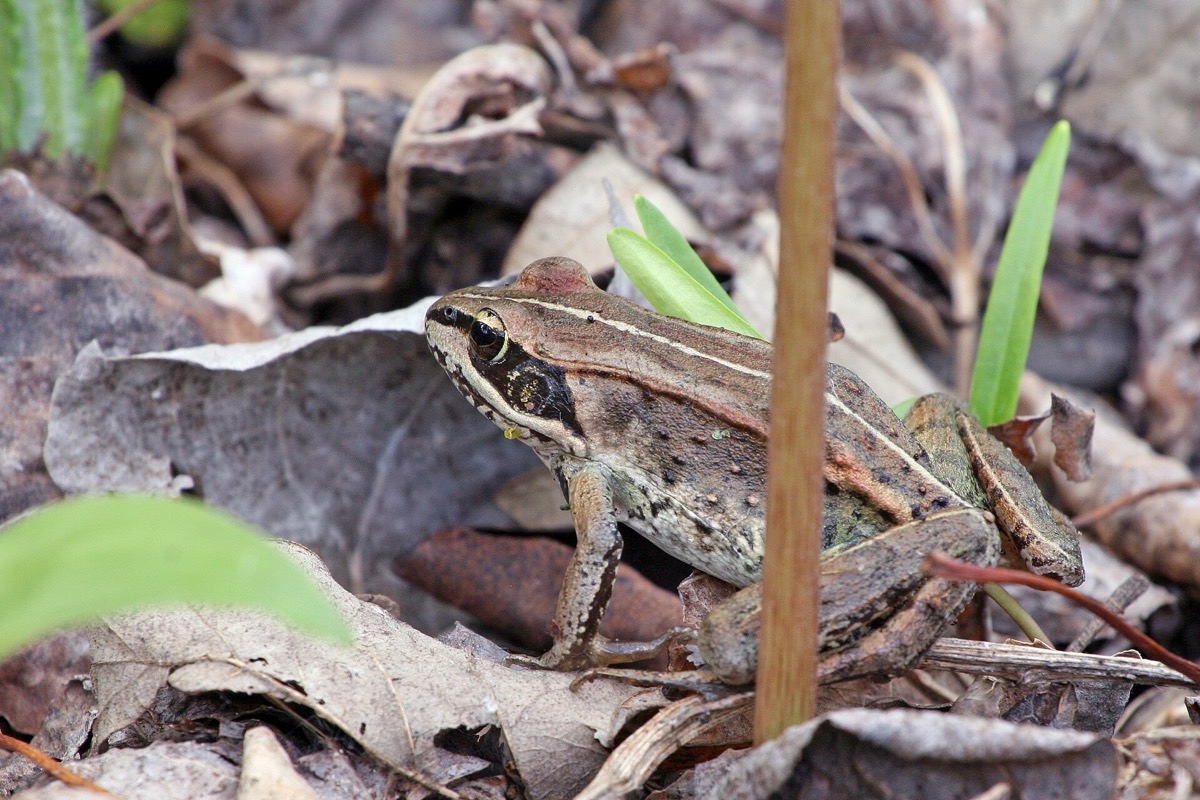
Wood frogs survive winter by freezing, which is already strange, and the ones in Interior Alaska live at the northern edge of the species range. A frog from southern Ohio is the same animal with the same trick. The question is whether the Alaskan ones simply endure more, or do something different.
They do something different, and the margin is large. Alaskan frogs survived freezing down to minus 16 degrees Celsius, some 10 to 13 degrees below what their southern relatives tolerate, and endured a two-month bout frozen at minus 4. Their winter preparation includes a 233 percent increase in the liver store.
Wood frogs winter in the leaf litter and freeze. The population studied here is indigenous to Interior Alaska, near the northernmost limit of the species range, which is the hardest version of that bargain anywhere the animal lives.
Their winter acclimatization is a chemical rebuild. The liver glycogen depot rose by 233 percent, subsidized by catabolism of the fat body and skeletal muscle. Plasma osmolality rose too, with reaching about 106 micromoles per milliliter plus an unidentified solute at roughly 73.
The comparison population, from cool-temperate southern Ohio, amassed much less glycogen, had a lower uremia at about 28 micromoles per milliliter, and apparently lacked the unidentified solute altogether. Same species, different chemistry.
Then the limits. Alaskan frogs survived freezing at temperatures as low as minus 16 degrees Celsius, some 10 to 13 degrees below what southern conspecifics tolerate, and endured a two-month bout of freezing at minus 4. The authors attribute it to high organic levels and , which limit how much ice forms.
wat. Alaskan wood frogs came back from minus 16 degrees Celsius, roughly 10 degrees past the limit for southern ones.
wat wat
The same species, a few thousand kilometers apart, carries two different winters in its chemistry, which is adaptation visible without waiting for a new species.
How do we know?
Costanzo and colleagues compared hibernation physiology in wood frogs from Interior Alaska and from southern Ohio, measuring the liver glycogen depot, plasma osmolality, urea levels and the temperatures each population survived.
What is still unknown
This compares two populations under controlled freezing, and one solute involved in the Alaskan response was never identified.
Learn something?