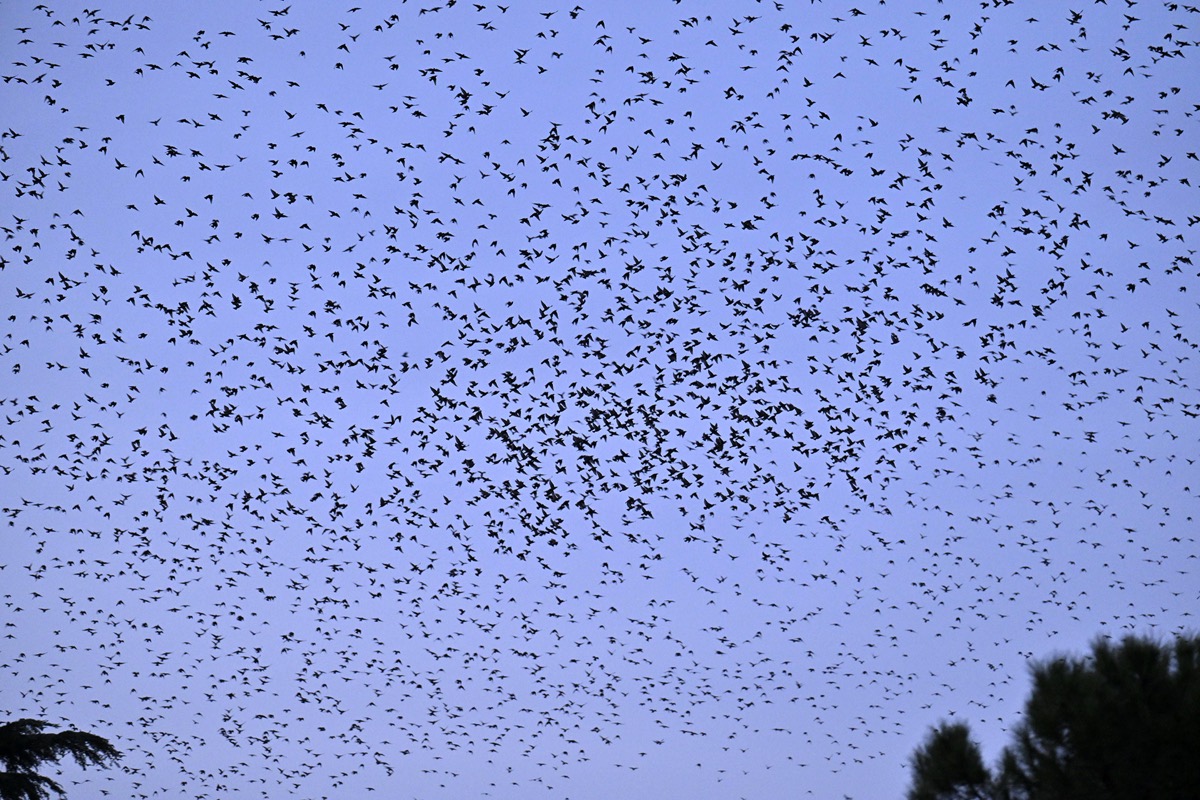
A flock of thousands turning as one looks like it needs a leader, and models have shown for decades that simple local rules are enough. The rule everybody assumed is distance: watch whatever is within a few body lengths. Very little was known about the real interaction. What are the birds doing?
Counting, not measuring. Reconstructing the of individual birds in flocks of a few thousand showed something else. Each bird interacts on average with a fixed number of neighbors, six or seven, rather than with everything inside a fixed distance. The rule travels with the bird as the flock thins and packs.
Numerical models have long shown that collective animal behavior can emerge from simple local rules among individuals. What stayed unknown was the nature of the interaction itself, so models and theories mostly rested on assumptions made in advance.
The measurement closed that gap. Reconstructing the three-dimensional positions of individual birds inside airborne flocks of a few thousand members gave the authors something to test rules against, rather than a silhouette.
The interaction does not depend on , as most models and theories assumed. Each bird interacts on average with a fixed number of neighbors, six to seven, instead of with every neighbor inside a fixed distance.
The argument for why is about survival. stays the same when density changes, and large density changes are exactly what a predator causes. Simulations confirmed it: topological interaction gave significantly higher of the aggregation than a standard metric one.
wat. A starling tracks a fixed number of neighbors, not everything within a fixed distance.
wat wat
The difference decides whether a flock survives being squeezed, which is what a predator does to it.
How do we know?
Ballerini and colleagues reconstructed the three-dimensional positions of individual birds in airborne flocks of a few thousand members, then tested metric and topological interaction rules against simulations.
What is still unknown
This is one species in field conditions, and the number six or seven is an average rather than a rule each bird obeys exactly.
Learn something?