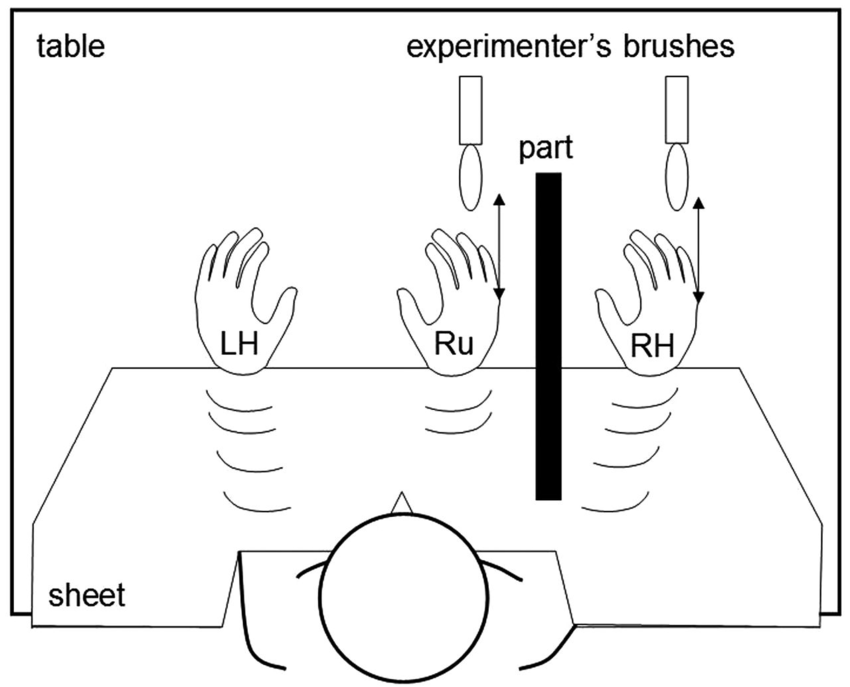
A brain is supposed to know where your hand is, which is about as basic as a sensation gets. In the experiment a real hand is hidden, a rubber hand is laid where it would be, and brushes are drawn across both at exactly the same moment. What happens then?
Within a few minutes many participants report that the touch feels as though it is coming from the fake hand, and some flinch when a hammer is raised over it. The control is what makes it a finding: move the brushing out of by a fraction of a second and the illusion almost vanishes. So the criterion the brain uses to identify its own body is an improbable coincidence, not a memory of what belongs to it.
The setup of looks like a conjuring trick and is carefully built. The participant’s hand is hidden behind a screen, and a rubber hand is laid in front of them where a real hand would be. The researcher draws two brushes at once: one over the hidden hand and one over the rubber hand, at the same rate and in the same place.
After a few minutes many report a strange sensation: the touch feels as though it comes from the rubber hand. Some of them flinch when somebody raises a hammer over it.
The detail that turns this into a finding is the control. When the brushing is out of synchrony, moved by a fraction of a second, the illusion barely appears. Which shows the brain is not leaning on prior knowledge of its own body. It leans on a coincidence hard to explain any other way: what is seen and felt together is probably the same thing.
So as not to rest on report alone, the researchers measured too. They asked participants to locate their hand with their eyes shut, and the pointing moved closer to the rubber hand by measurable centimeters. The conclusion is that of a body is not a fixed fact but an inference the brain draws again continuously. And not everyone experiences the illusion as strongly.
wat. When the eye and the touch agree in time, the brain may add a rubber hand to its map of the body.
wat wat
The illusion shows that the sense of owning a body is produced by a continuous combination of vision, touch and position.
How do we know?
The researchers compared synchronous with asynchronous brushing, collected reports, and measured how far off participants pointed when asked to locate their own hand.
What is still unknown
Not everyone experiences it as strongly, and a verbal report can be shaped by what the participant expects the experiment to show.
Learn something?
Where to next
 Does holding someone’s hand change what fear looks like in the brain?touch
 Does a hug from your partner before a stressful moment do anything measurable?touch
 The bowerbird lays out stones in front of its bower. Why do they get smaller?illusion