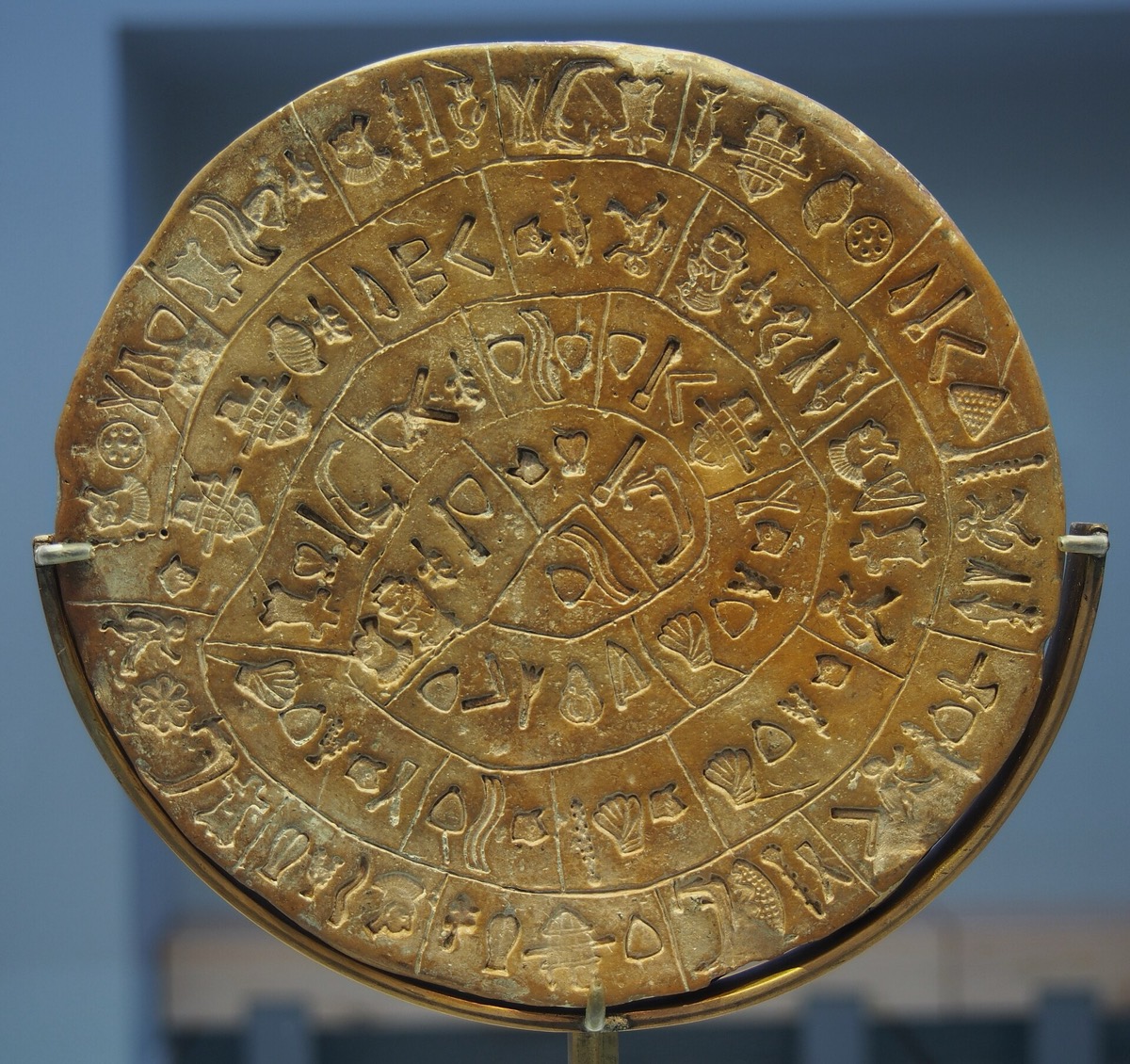
Luigi Pernier found it in a room of the Palace of Phaistos on the third of July, nineteen hundred and eight: a clay disc from around seventeen hundred BC, with signs arranged in a spiral. Both sides were while the clay was still wet. A vertical line with five dots marks where to start and which way to go. So why is it still unread?
Too little of it exists, and nothing to compare it to. The disc carries two hundred and forty-one signs in total, arranged in sixty-one groups separated by incised lines and presumably representing words. Its uniqueness is the problem: experts have reached no definitive conclusion about the contents, or about any relationship to the three pre-alphabetic scripts of the prehistoric Aegean.
The Italian archaeologist Luigi Pernier found the Phaistos Disc in a room of the Palace of Phaistos on the third of July, nineteen hundred and eight. It is one of the most iconic yet enigmatic artefacts of the civilization. The disc is clay, dated to about seventeen hundred to sixteen hundred and fifty BC, with inscriptions arranged in a spiral on both sides.
The manufacture is unusual. The signs were impressed with tiny seals before firing, while the clay was still wet, rather than scratched or drawn. Two hundred and forty-one signs appear in total. A vertical line with five dots on the outer edge of each side marks the beginning and the direction of reading, from the edge toward the center.
The content has a visible structure. The , often depicting people, birds, plants and ships, fall into sixty-one groups separated by vertical or radiating incised lines, and those groups presumably represent words. Certain groups of signs repeat like a refrain, which the museum calls the strongest evidence that the inscription is a hymn or an incantation.
That is as far as anyone has got. The disc has attracted many attempts at decipherment precisely because it is unique, and uniqueness is also why they fail. No second text exists, no bilingual, and no agreed relationship to , Cretan Hieroglyphic or Linear B. Experts have not reached a definitive conclusion on the contents or on where the script belongs.
wat. Two hundred and forty-one signs is a page. A page in a script used nowhere else is not enough to break.
wat wat
Decipherment needs repetition and a crib. A single object in a script nobody else used supplies neither, which is a limit on method rather than a failure of ingenuity.
How do we know?
The Heraklion Archaeological Museum, which holds the disc, describes its discovery, its physical form, the arrangement of the signs and the state of attempts to decipher it.
What is still unknown
The museum notes that the strongest evidence about the content is the repetition of certain sign groups, which suggests a hymn or incantation. That is an inference from structure, not a reading.
Learn something?