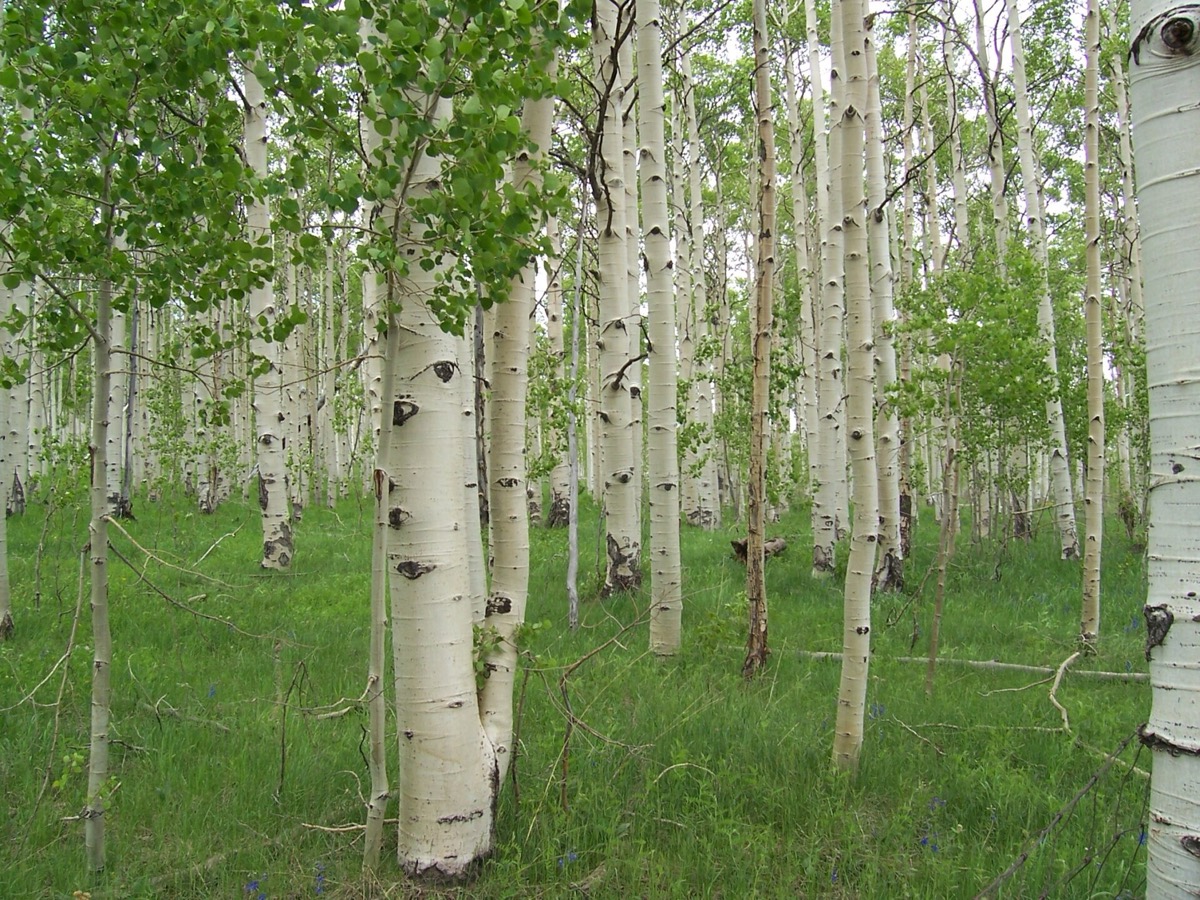
An aspen stand in south-central Utah covers one hundred and six acres of the . Every trunk in it is genetically identical to every other, because aspens spread by sending up shoots from a shared root system rather than by seed. Researchers named it , Latin for I spread, believing it to be the largest living organism by mass on earth. And it is now in trouble.
Pando is dying from the middle of its life cycle outward. Forest managers have recorded a rapid loss of mature stems with no young trees coming up to replace them, which is an unsustainable structure for a clone that persists only by replacing its own parts. Rogers and colleagues attribute the imbalance to human interventions, and argue restoration will rest on protection, monitoring and innovation.
Aspens reproduce by spreading. A clone sends up stems, called , from a shared root system, and every one of them carries the same genes. A patch that looks like a forest of separate trees can therefore be a single organism, with the trunks functioning more like leaves on a longer timescale.
The clone in the Fishlake National Forest in south-central Utah covers one hundred and six acres, about forty-three hectares. Researchers named it Pando, Latin for I spread, on the view that it is the largest living organism by mass on earth. The claim rests on the extent of the clone, not on the size of anything you could stand next to.
Recently forest managers have noted a rapid dying of mature stems without of younger trees. For an organism that persists by replacing its own parts, that combination is fatal in slow motion. Rogers, Gale and McAvoy describe the situation as unsustainable, and it has galvanized restoration efforts on the site.
They are direct about the cause: human interventions produced the imbalance, and restoration will rely on protection, monitoring and innovation. Their closing argument is that Pando works as a laboratory. A forest icon whose decline we caused and are now trying to reverse may yield insights for much broader human-nature interactions.
wat. Forty thousand trunks, one root system, one set of genes. The forest is the individual, and the trees are its parts.
wat wat
A single organism that survives by constant replacement has no old age to speak of and no fixed death date. It only dies when the replacement stops.
How do we know?
A Utah State University Extension brief by Paul Rogers, Jody Gale and Darren McAvoy sets out what the clone is, what managers have observed happening to its stems, and what restoration would require.
What is still unknown
A short extension brief rather than a study. It states the acreage, the clonal structure and the decline without the stem counts, the genetic work or the age estimates behind them.
Learn something?