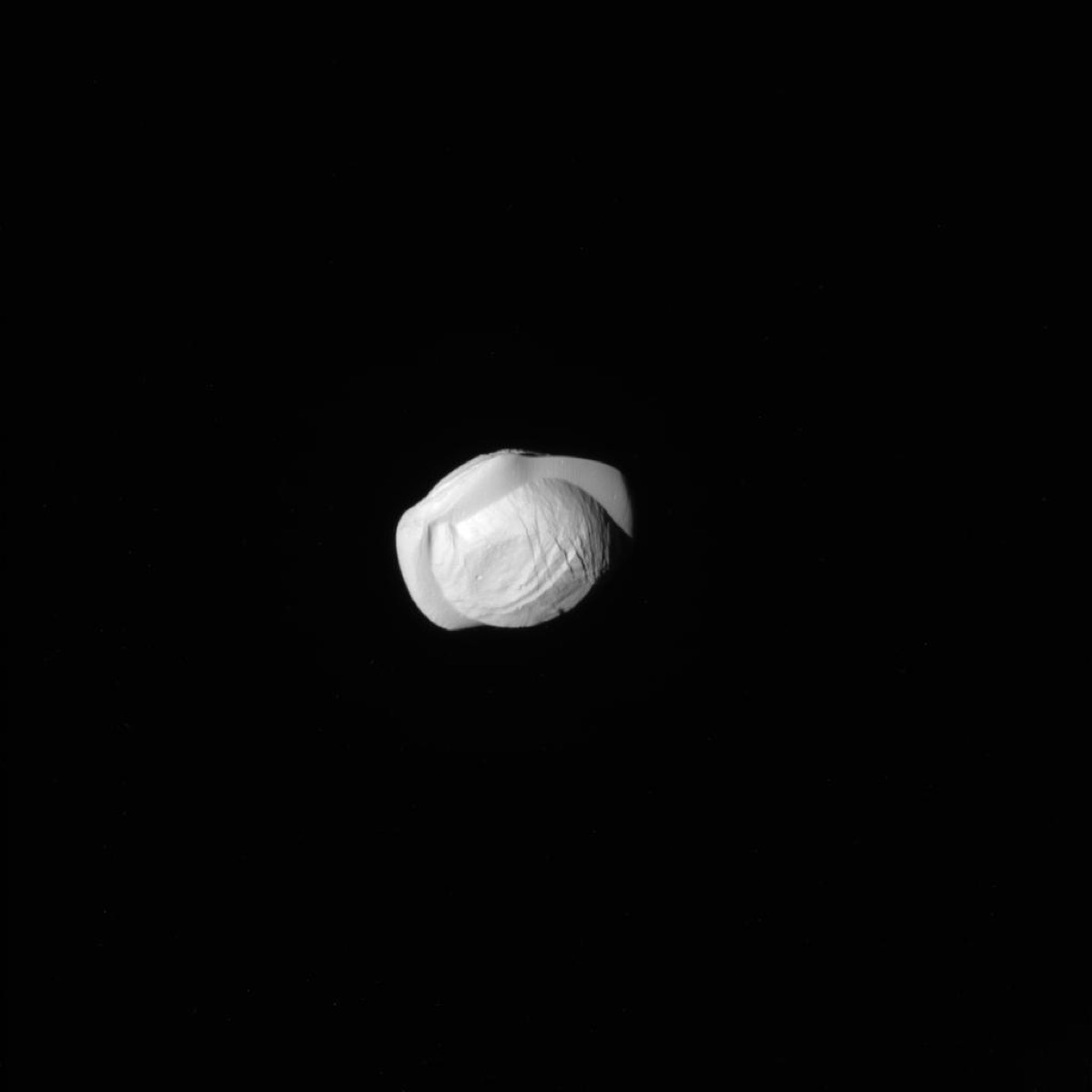
Pan orbits inside a gap in Saturn’s rings. Photographs show a small moon with a smooth ridge running right around its equator, wide enough to make the whole thing look like a dumpling or a saucer. Atlas has one too, and Daphnis. A ridge that sits exactly on the equator is a clue about where the material came from.
It was accreted from the rings the moon is ploughing through. Quillen and colleagues model ridge growth from ring material. It works as long as the torque from the arriving material does not exceed the from Saturn that keeps the moon tidally locked. That sets a maximum accretion rate and a minimum time for the ridge to grow.
The ridges are the feature to be explained. Pan, Atlas and Daphnis all orbit within Saturn’s rings, and all carry what the authors call ornamental equatorial ridges. The question is whether those can be built from ring material rather than being a leftover of the moons’ formation.
The physics sets a budget. Accretion of complex shaped ridges from ring material should be possible when the torque from the accreted material does not exceed the tidal torque from Saturn that ordinarily maintains tidal lock. That gives both a limit on the maximum accretion rate and a minimum duration for the ridge to grow, so a ridge is also a clock.
Shape comes from geometry. The authors explore where in longitude material lands, starting from ring particles on circular orbits and a moon on a circular, inclined or eccentric orbit. Sloped and lobed ridges can be accreted if the moon during accretion as its shape changes. They can also form if the surface density profile at the disk edge lets material from different initial orbits strike different places on the ridge. Accretion from an might account for a depression on Atlas’s ridge, and at an eccentricity near the Hill value it might produce the multiple lobes seen on Pan.
Two scenarios come out promising, and they may be connected. The moon migrates through the ring, narrowing its gap and so making accretion easier. And its orbital eccentricity rises through with another moon, pushing it into its own gap edges, where the material is. Either way the saucer is a record of traffic rather than of birth.
wat. The moon did not grow a belt. The rings laid one on it, one grain at a time, along the only line that stays still.
wat wat
The shapes are not decoration. A lobed or sloped ridge records how the moon’s orbit and its gap in the rings were changing while the material was landing.
How do we know?
An Icarus paper exploring accretion scenarios for the ornamental ridges on Pan, Atlas and Daphnis. It follows where ring particles on circular orbits land on a moon that is itself on a circular, inclined or eccentric orbit.
What is still unknown
A modeling study of scenarios rather than a reconstruction of one moon’s history. Several routes to the observed shapes work, which is why the paper ends with two candidates rather than an answer.
Learn something?