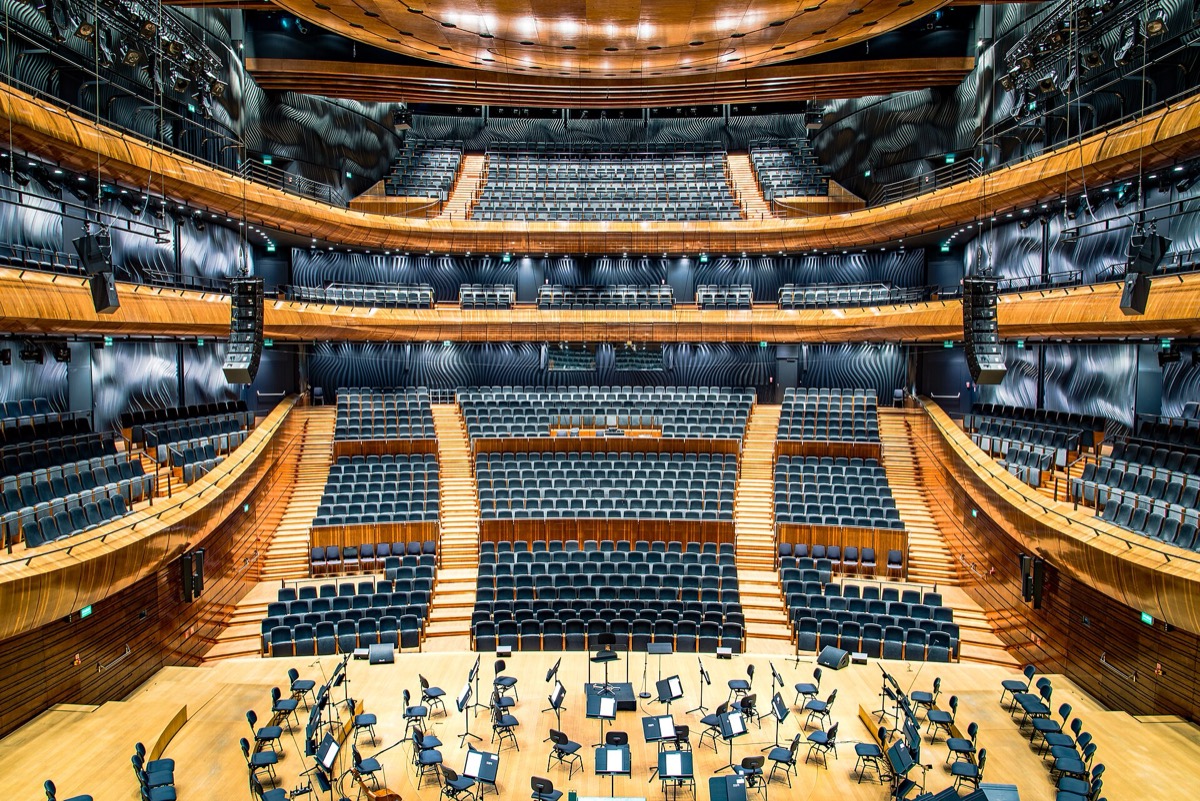
Not on this evidence. Lokki and colleagues note that studies often treat a hall’s acoustics as a single entity, then show that they are not. The acoustics vary between seats, and the choice of music changes what listeners perceive. Twenty-eight assessors compared six unoccupied halls, and they did not agree with each other either.
The listening tests used two music excerpts at three different seats in each hall, with assessors rating halls by on their own preference and on . The assessors fell into two that prioritize different perceptual factors. The attributes they came up with on their own clustered into three latent classes.
Some studies of concert hall acoustics consider the acoustics of a hall as a single entity, which is how a hall ends up with a reputation. Lokki, Pätynen, Kuusinen and Tervo set out to test that framing, and found two things wrong with it. The acoustics vary between different seats, and the choice of music also influences the perceived acoustics.
The design is built to separate those effects. Six were compared with extensive listening tests, applying two different music excerpts at three different seats. Twenty-eight assessors then rated the halls using a paired comparison method, judging both their own subjective preference and individual attributes they elicited themselves.
Letting assessors supply their own vocabulary matters more than it sounds. A checklist of qualities decides in advance which dimensions count, whereas eliciting attributes and clustering them afterward shows what listeners are attending to. Here those attributes fell into three latent classes.
The preference results are where a ranking breaks down. Assessors could be classified into two groups which prioritize different perceptual factors, meaning the disagreement between listeners is structured rather than noisy. Two cautions bound all of it. The halls were unoccupied, and an audience changes a room acoustically. And two excerpts, however carefully chosen, are not a repertoire.
wat. Which hall sounds best depends on your seat, the music, and which listener you ask.
wat wat
Hall rankings assume one scale. If listeners split into groups with different priorities, then a ranking is averaging away the disagreement that is the actual result.
How do we know?
Extensive listening tests compared six unoccupied concert halls, applying two music excerpts at three seats, with twenty-eight assessors rating them by paired comparison on preference and on attributes they elicited themselves.
What is still unknown
Unoccupied halls, reproduced excerpts and twenty-eight assessors. An audience changes a hall’s acoustics, and two excerpts cannot represent a repertoire, so the finding is about the existence of the variation rather than its full size.
Learn something?
Where to next
 Can an audience in a hall really hear a Stradivarius?music
 Does a Mozart sonata really reduce epileptic seizures?music
 Why is a wholly predictable song boring, and a wholly surprising one exhausting?music