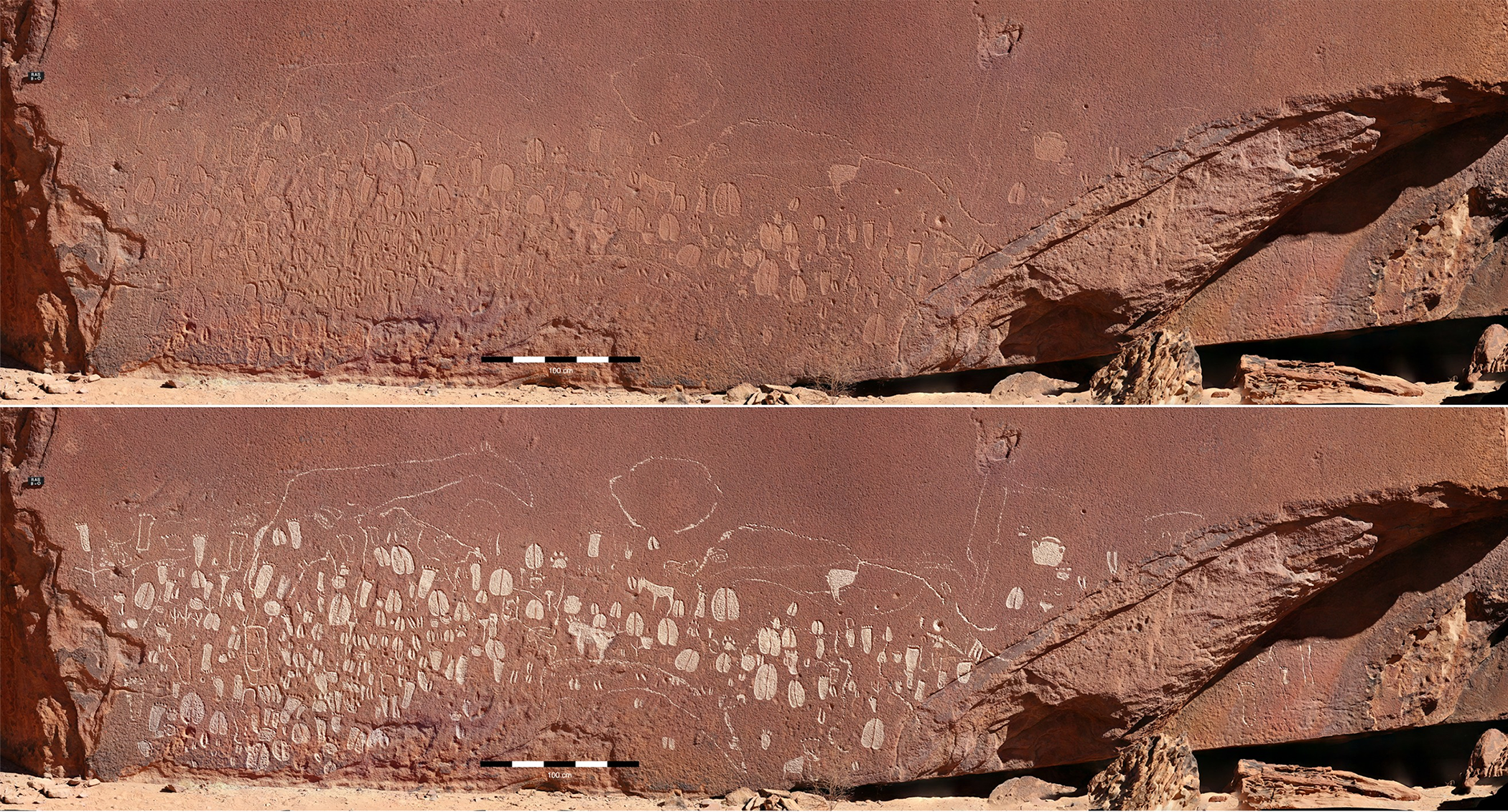
Rock in the ! nawas mountains in Namibia include hundreds of marks that look like tracks, and archaeologists used to record them as general shapes. Then Indigenous from the Kalahari region were invited to examine them. What did they see there?
Far more than a shape. Across 513 engravings, in more than 90 per cent of them the experts could identify the species, the age group and the of the animal, and even which leg is represented. The conclusion is not that the stone holds a real footprint, but that the artist engraved precise information an untrained eye misses.
An animal track is not only a silhouette. Whoever follows animals can learn from its shape and proportions about the body and the movement. The researchers asked whether rock engravings can hold that kind of information too.
Experts from the Kalahari region examined 513 engravings of animal tracks and human footprints in the Doro! nawas mountains. In the large majority they proposed a detailed identification of the species, the age, the sex and the leg represented.
The variety identified in the engraved tracks was richer than the variety visible in pictures of whole animals in the same tradition. The makers of the engravings may have chosen deliberately what to show through tracks, rather than using them as geometric decoration.
You cannot ask the artists why they engraved one animal rather than another. Nor does an expert identification turn every detail into archaeological certainty. But the work shows how much information is lost when tracks are classified as shapes without involving the people who know how to read them.
wat. In more than 90 per cent of 513 engraved tracks in Namibia, tracking experts identified details of the animal and of the leg represented.
wat wat
Involving experts who know tracks from the field changes what can be learned from an archaeological find that was already in plain sight.
How do we know?
Tracking experts examined engraved footprints in the field and proposed a detailed identification for each one; the researchers analyzed the patterns of identification against descriptions of the animals at the site.
What is still unknown
The identifications are expert interpretation of an engraving, not a DNA test of the animal. The patterns of engraving in this region do not necessarily represent all ancient rock art.
Learn something?