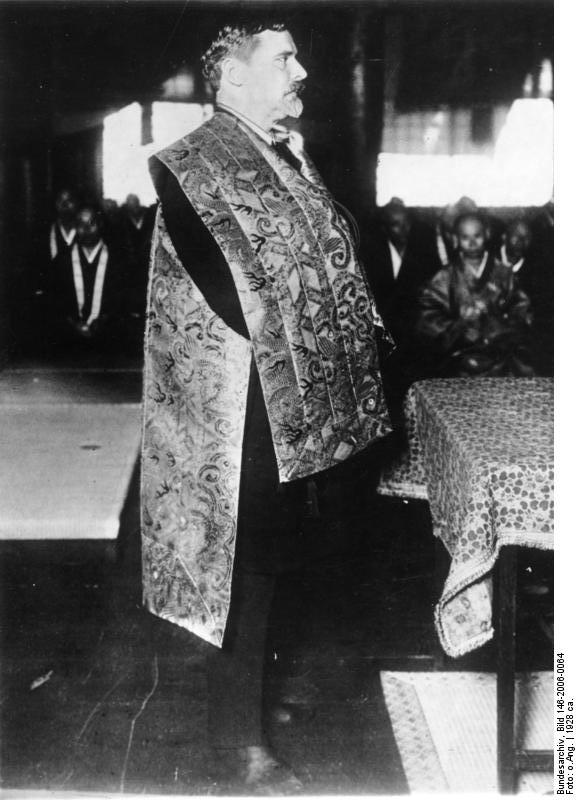
A prescribed circuit, repeated. The kaihōgyō is a form of carried on at on Mount Hiei, the sect’s headquarter temple. The practitioner walks a set nineteen-mile route, about thirty kilometers, around the mountain and its environs, stopping to offer prayers at the various halls, shrines and other holy sites along the way.
So it is not an endurance event with a religious theme. The prayers are the practice and the walking connects them, which is why the route is prescribed rather than chosen and why it passes the sites it does. Rhodes notes the practice has caught the imagination of many Japanese people interested in religion and spirituality.
The kaihōgyō is a unique form of Tendai mountain asceticism, carried on at Enryaku-ji on Mount Hiei, the headquarter temple of the sect. The practitioner walks a prescribed , about thirty kilometers, around Mount Hiei and its environs. Prayers are offered at the various halls, shrines and other holy sites along the way.
That description settles what kind of thing it is. The route is prescribed, not chosen, and it is laid out by where the holy sites are. The walking is what connects the stops, so the distance is a consequence of the geography of devotion rather than a figure anyone set out to cover.
It has also become visible outside Tendai circles. Rhodes notes that the practice has recently caught the imagination of many Japanese people interested in religion and spirituality. Books and articles have been published on it, some scholarly and many popular. NHK, Japan’s national public broadcaster, aired a critically acclaimed program on the subject.
Rhodes’s article sets out to give a short introduction, first outlining the history of the practice and then briefly describing how it is practiced today. One caution follows from that scope. This is an introduction rather than a study. It establishes the route, the setting and the religious frame, and not the physical demands or completion rates that the comparison with marathon running invites.
wat. Nineteen miles around a mountain, stopping to pray the whole way.
wat wat
Thirty kilometers a day is an athletic number, and this is not athletics. The distance exists because of where the holy sites are, so the walking follows from the devotion rather than being its point.
How do we know?
An article in the Japanese Journal of Religious Studies introduces the practice, outlining its history and then describing how it is carried out today at Enryaku-ji.
What is still unknown
A short introduction to the practice rather than a study of it, written to outline history and current form. It gives the route and the setting, not the physiology or the completion rates that a sports account would want.
Learn something?
Where to next
 What is the human body unusually good at?endurance
 Does beetroot juice actually make you faster?endurance
 At what age does an athlete peak, and what does it depend on?endurance