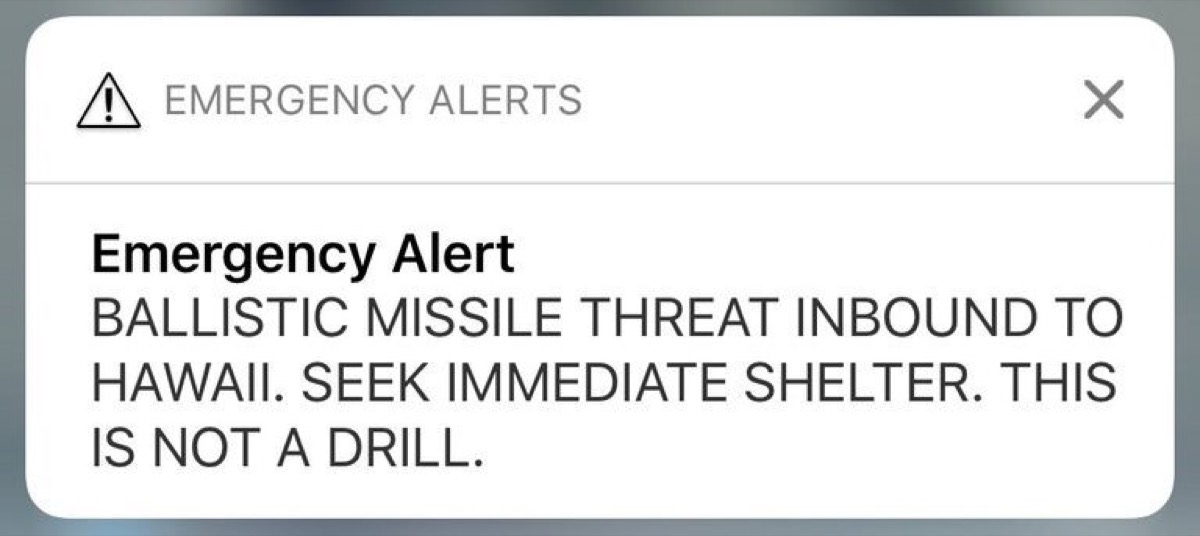
At 8:07 in the morning on 13 January 2018, every phone in Hawaii received a warning of an inbound ballistic missile, ending with the words THIS IS NOT A . There was no missile. An internal exercise at the state emergency agency had gone out to the public instead. What happened over the next half hour?
Thirty-eight minutes of fear, because nobody had built an undo. The alert went out through the same systems that carry a real one, and some residents suspected an error, partly because no air-raid sirens sounded. Officials knew quickly, and the correction did not reach phones for 38 minutes. Sending was a designed, fast action, and was not a scenario anybody had prepared for.
The phrase at the end of the message has a history in Hawaii. A naval officer used it in December 1941: AIR RAID ON PEARL HARBOR, THIS IS NOT DRILL. A carried it again to the phones of residents in January 2018.
The cause was an internal exercise. Officers at the state emergency management agency set out to run a ballistic missile defense drill through the Emergency Alert System and Wireless Emergency Alerts. Just after eight in the morning, the process they completed sent a real alert to the public instead.
Some residents doubted it immediately, partly because no air-raid sirens sounded, and called around or checked social media. For many others it created the expectation that a missile strike might be minutes away, and the alert stood uncorrected in the system for 38 minutes.
The gap is the finding. Sending was fast because it was designed to be; cancelling was slow because nobody had designed it at all. That is why the investigation treated this as more than , focusing on the procedure, the interface and the approvals rather than on the person who completed the steps. The lasting damage is the attention people will pay to the next alert.
wat. It took 38 minutes for Hawaii to correct a false missile alert in the system that had sent it.
wat wat
Trust in emergency alerts depends on the ability to correct a mistake in the same channel and within minutes, because the real cost arrives the next time the danger is real.
How do we know?
The Public Safety and Homeland Security Bureau of the Federal Communications Commission investigated the timeline, the messages and the agency’s procedures, through in-person and telephone interviews and a review of its documents.
What is still unknown
The report documents procedures, timings and documents, so it cannot capture what the morning felt like for any individual resident.
Learn something?