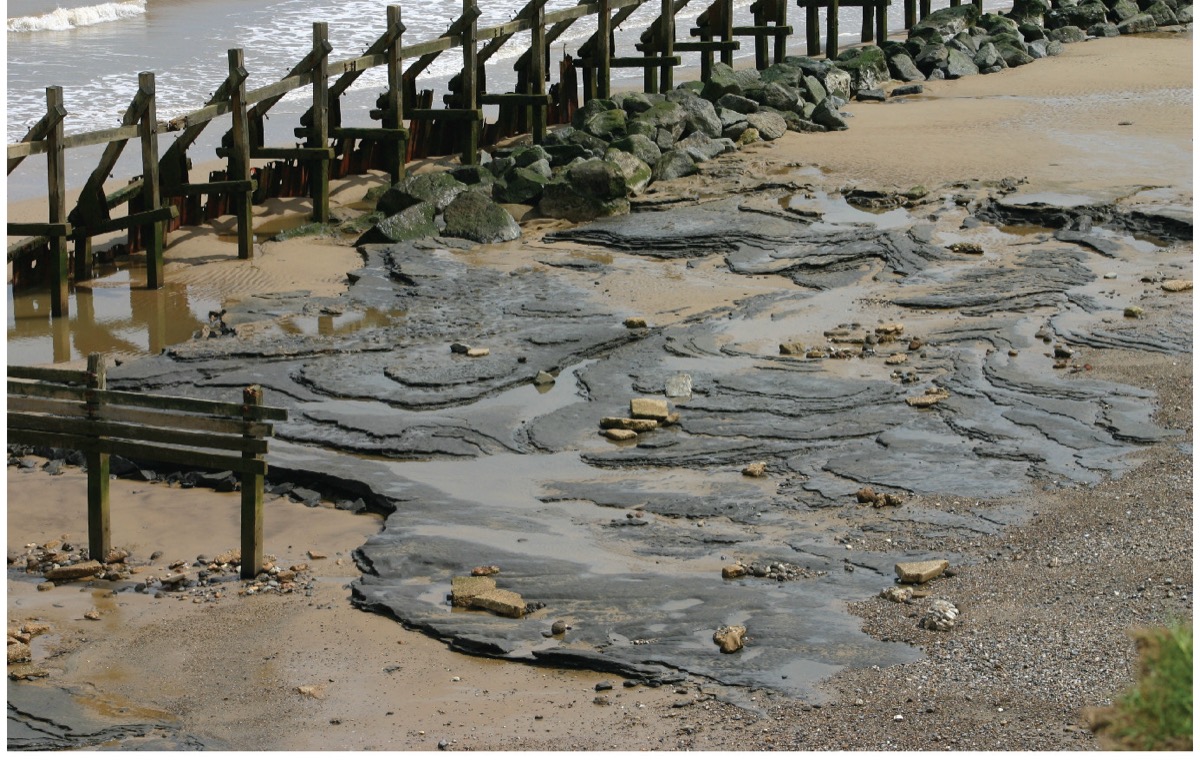
Along the shore at in England lay exposed for a few hours, and the researchers photographed it quickly before the waves wore it away. In the mud were elongated hollows, though whose they were cannot be known for certain. Who walked there, and when?
Someone very early, and very far north. The age of the layer, roughly 780,000 to a million years, places these among the oldest human footprints found outside Africa. Exactly who walked there cannot be identified with confidence, and the prints do show that early humans reached this far north long before modern humans did.
In 2013 a fossil mud surface was exposed on the beach. The erosion that created the window for studying the surface also threatened to destroy it, so the recording was done fast.
In the the researchers identified many elongated hollows across some 12 square meters. Some showed details such as an arch and toes, and the sizes fitted a group of different ages.
The age of the sediments was estimated at roughly 780,000 to a million years. Early humans lived in Europe at such a time, and the site yielded no bones, so cannot be named as the one that passed through.
The prints are rare evidence of behavior and of a group’s possible composition, not a full picture of its journey. Some of the hollows are faint, so the inference rests on the assemblage as a whole.
wat. Coastal mud in England preserved the footprints of early humans from roughly 780,000 to a million years ago.
wat wat
A footprint preserved for a moment on a shore lets us see the presence of a group that left no identifiable skeleton there.
How do we know?
Photography from many angles produced a three-dimensional model of the mud surface; the shape of the hollows and the age of the sediment layer were examined against further environmental evidence.
What is still unknown
No bones of the print-makers were found at the site, so assigning them to a particular human species remains a hypothesis.
Learn something?