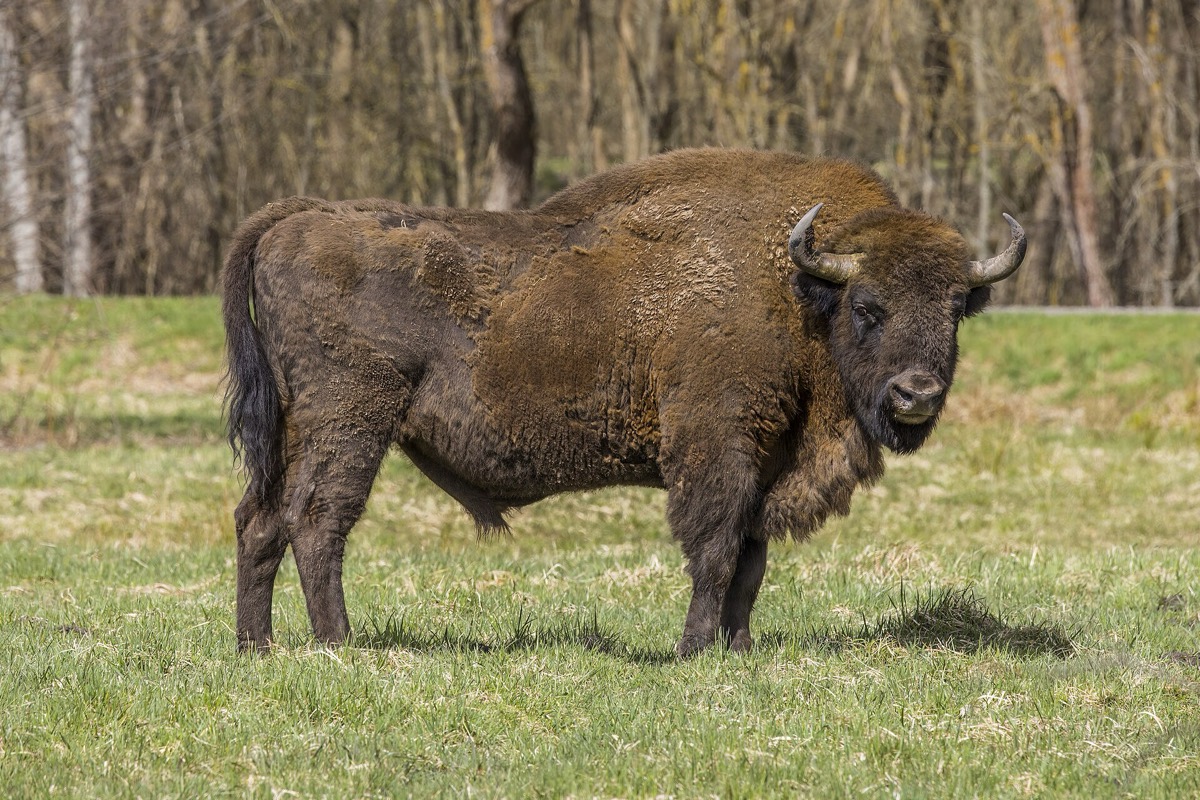
The European bison is Europe’s largest living wild land mammal, and it came within a few dozen animals of disappearing. When the last wild one was shot in the Caucasus in 1927, every survivor was in captivity. Rebuilding a free-living population from that starting point is a long experiment in conservation, and Rewilding Europe gives both the recovery figures and what the recovery has not fixed.
From 54 captive animals to about 7,000 ones. Only 54 European bison were alive in 1927, all in captivity, and the first were released back into the wild in Poland’s Białowieża Forest in 1954. Over the last ten years the estimated free-roaming population rose from 2,579 individuals to around 7,000, with the largest herds in Belarus and Poland. In 2020 the IUCN moved the species from Vulnerable to Near Threatened.
The European bison is Europe’s largest living wild land mammal, with fully grown bulls occasionally tipping the scales at over 850 kilograms. It once roamed across almost the entire continent, excepting parts of Spain, Italy and northern Scandinavia. Sustained hunting and habitat loss shrank its range across the centuries, until the last wild animal was shot in the Caucasus in 1927, leaving only 54 alive and all of them in captivity.
From that point the recovery has been slow and deliberate, supported by breeding programmes and reintroductions, with the first bison released back into the wild in Poland’s Białowieża Forest in 1954. Over the last ten years the estimated number of free-roaming European bison has risen from 2,579 individuals to around 7,000, with the largest herds in Belarus and Poland.
Since 2004 most restoration work has been guided by a Bison Action Plan from the IUCN’s Species Survival Group, produced with conservation partners. Its aims are to increase population size, preserve genetic variability and let free-ranging populations function as a natural part of European ecosystems. The milestone came in 2020, when the species moved from Vulnerable to Near Threatened on the IUCN .
The remaining problems are the reason a recovered count is not a recovered species. Rewilding Europe lists an extremely small gene pool, traceable to 12 , along with hybridization with American bison, new diseases and epidemics, limited living space, isolation, poaching and insufficient habitat for reintroduction. At present only eight free-living sub-populations are of , taken as 150 animals, with most sub-populations small and isolated. A second Bison Action Plan is under development.
wat. Europe rebuilt its bison from fifty-four captive animals to seven thousand wild ones, on a gene pool of twelve founders.
wat wat
The headline numbers hide the fragile part. Twelve founding animals means the gene pool is extremely small, and only eight free-living sub-populations are of viable size, so a recovered count is not the same as a recovered species.
How do we know?
Rewilding Europe’s impact story on the European bison gives the population figures, the reintroduction history, the IUCN Red List change, the Bison Action Plan and the remaining threats.
What is still unknown
This is a conservation organization writing about work it carries out itself, so it is an interested account. The population figures are estimates, and the piece is framed as an impact story.
Learn something?