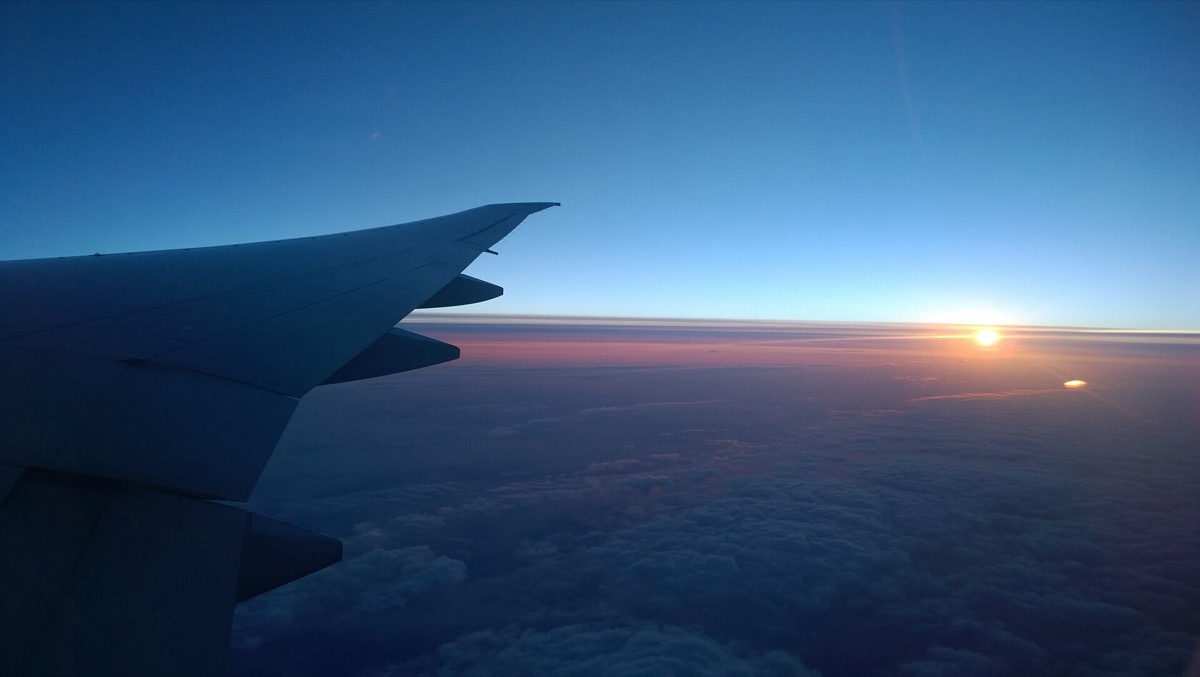
Most internal clocks run a little longer than 24 hours. Flying west means staying up later, which stretches the day, and flying east means cutting it short. Researchers modeled the clock cells of the brain as thousands of coupled and moved the light cycle abruptly to simulate a flight. Which direction does the body forgive?
West, because stretching is the direction the clock already leans. The model treats the suprachiasmatic nucleus as a large population of coupled phase oscillators with differing natural frequencies, driven by a daily cycle of light. Shifting that drive suddenly, as a flight does, leaves the population resynchronizing through a where east and west are not symmetric at all.
The familiar explanation for the east-west asymmetry is that the runs slightly longer than 24 hours, so lengthening a day is easier than shortening one. That is true and it is not the whole mechanism.
This work models the suprachiasmatic nucleus explicitly with a forced : a large population of coupled phase oscillators with heterogeneous intrinsic frequencies, driven by a periodic signal standing for sunrise, sunset and alarm clocks.
The mathematics then does something useful. The dimensionality of such a system can be reduced with the Ott-Antonsen ansatz, which makes the dynamics tractable, and the parameters were estimated from previous biological experiments rather than chosen to fit the conclusion.
Travel enters as a sudden change of clock phase. Following the system through its phase space afterwards shows why the severity differs by direction. Resynchronization after an eastward shift can take the population on a far longer path than the equivalent westward one. It remains a model, and the asymmetry it reproduces is the one travellers report.
wat. The body stretches a day more easily than it shortens one, so flying east usually produces the longer jet lag.
wat wat
The direction of travel changes how long adaptation takes, so timing light and sleep should follow the direction rather than only the number of time zones crossed.
How do we know?
Lu and colleagues used the forced Kuramoto model with parameters estimated from earlier biological experiments, and reduced the system using the Ott-Antonsen ansatz. A sudden change of clock phase then stood in for crossing time zones.
What is still unknown
This is a mathematical model rather than a flight experiment on people. Age, daylight hours, departure time and sleep habits all move the personal experience.
Learn something?
Where to next
 Why is exhaustion from a long flight not always jet lag?jet lag
 What keeps time in a body that has no clock in it?circadian rhythm
 Why is a weather forecast so sensitive to a tiny change?models