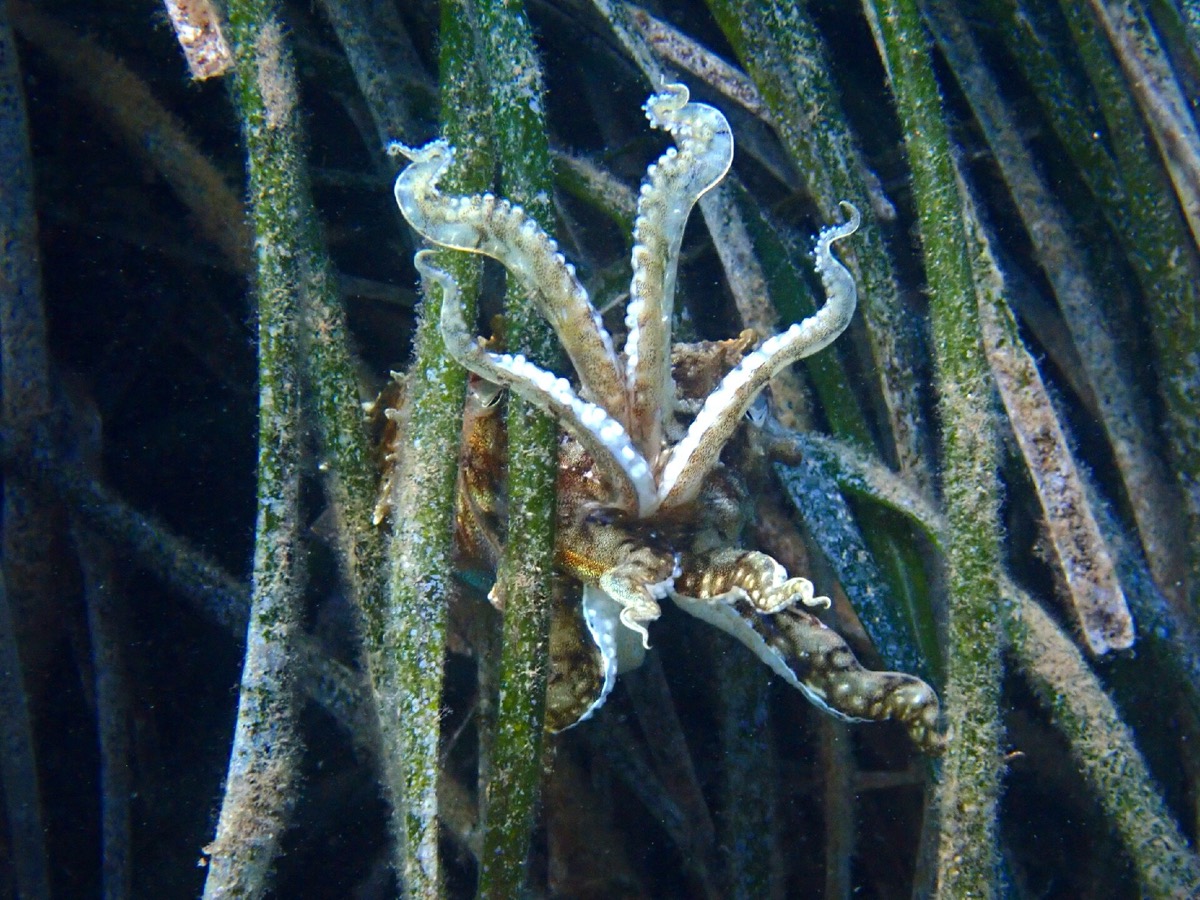
Waiting for something better is cheap to describe and expensive to do, and across animals the tolerable delay runs from a few seconds to several minutes. The long waits belong to large-brained vertebrates, all of which face broadly similar social and ecological pressures, so nobody can say which pressure built the ability. A cuttlefish faces partly different ones. How long will it hold out?
Between fifty and a hundred and thirty seconds, which is vertebrate territory. Cuttlefish in a passed up an immediately available prey item to wait for a better one, sustaining the wait for up to 130 seconds. A separate then showed something tidier: the individuals who waited longest were also the ones who learned fastest when the rewarded stimulus was switched.
varies enormously across animals. Some species can hold off for a few seconds, while large-brained vertebrates manage several minutes, and the longer waits have been linked to better performance on cognitive tasks generally.
The trouble with that literature is that the species in it are too similar. Primates and corvids face broadly comparable social and ecological pressures, so the candidate explanations for why self-control evolved cannot be pulled apart. A cuttlefish is an whose pressures only partly overlap, which is why it is worth testing.
A delay maintenance task measured the ability directly: an immediately available prey item against a better one that would arrive after a wait. The cuttlefish maintained delays of up to 50 to 130 seconds, which puts them in the range of some large-brained vertebrates rather than in the few-seconds range.
A reversal-learning task then asked about flexibility, requiring each animal to associate a reward with one of two stimuli and afterwards with the other. The cuttlefish that had delayed gratification longest showed the better learning performance. That pairing is the paper’s most interesting line and also its softest, since it is a correlation across a small number of captive individuals and says nothing about which ability drives the other.
wat. A cuttlefish will stare down a perfectly good shrimp for two minutes, and the ones who hold out longest also learn fastest.
wat wat
The vertebrates studied so far are too alike to separate the candidate causes of self-control. An invertebrate on a different evolutionary path reaching comparable delays makes the ability look like a general solution rather than a vertebrate specialty.
How do we know?
Schnell and colleagues gave cuttlefish a delay maintenance task, measuring how long each would forgo an immediate reward for a better delayed one. A reversal-learning task paired the reward with one of two stimuli and then the other.
What is still unknown
A small number of captive cuttlefish, and the link between waiting and learning is a correlation across individuals, so nothing here shows that self-control produces the better learning.
Learn something?
Where to next
 What was left of the marshmallow test when they ran it on ten times as many children?self-control
 You were told you are a visual learner. Should you be taught only in pictures?learning
 Does living abroad really make a person more creative?learning