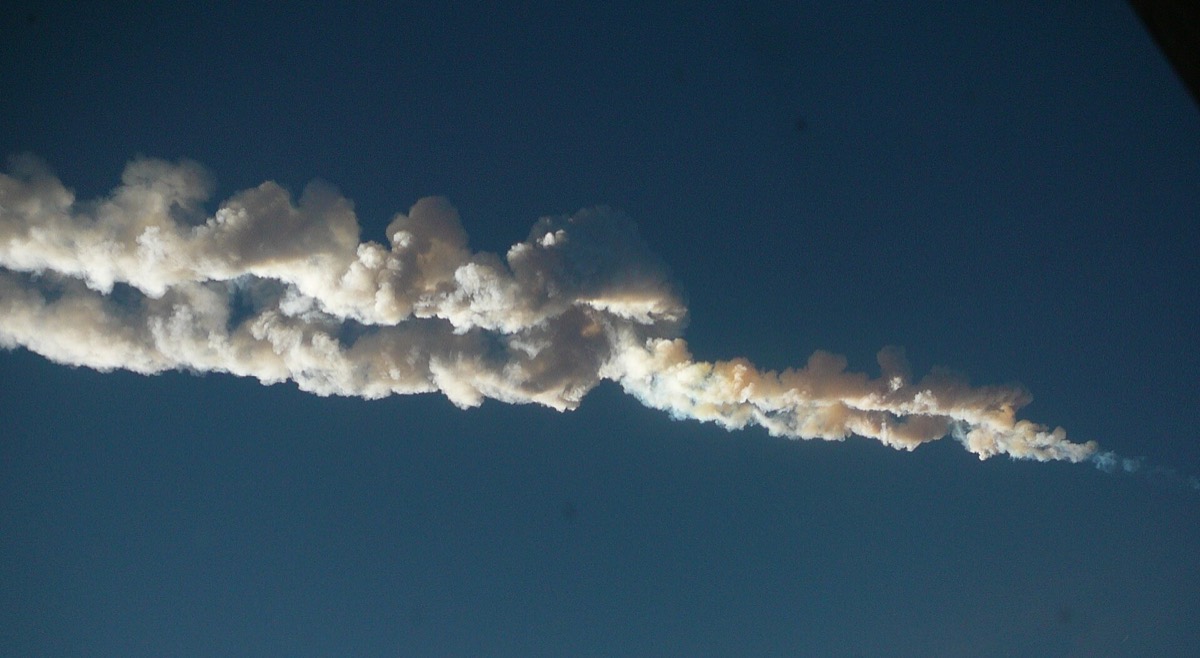
In February two thousand and thirteen an object about seventeen meters across came apart in the atmosphere over the Chelyabinsk region of Russia. Nothing of consequence landed on anyone. More than one and a half thousand people were hurt anyway, and almost all of the injuries shared one cause, which says something uncomfortable about how modern buildings meet a .
Window glass. The shock wave from the breaking object shattered windows across the region, and most of the injured were hurt by the flying glass rather than by anything from space. Britannica puts an event involving a body that size at about , which makes this the ordinary case rather than the freak one.
Collisions between astronomical bodies are continuous and almost entirely harmless. Small objects, among them, constantly hit Earth’s atmosphere and either burn up or settle as dust. Damage begins only with larger bodies, and the biggest projectiles, infrequent as they are, pose the greatest danger of all.
Chelyabinsk is the case that shows where the threshold sits. A meteorite seventeen meters, or fifty-six feet, wide broke up in the atmosphere over the Chelyabinsk region of Russia in two thousand and thirteen. More than one thousand five hundred people were injured, mostly by flying glass that the shock wave had shattered.
The frequency matters as much as the number hurt. An impact by a body the size of the Chelyabinsk object is expected about once per century, so this is not a once-in-recorded-history event like Tunguska but a recurring hazard. The scale above it is named bluntly: near-Earth objects larger than about a hundred and forty meters are called , and those above a kilometer planet-killers.
One detail puts the risk in proportion. Britannica notes that the only verified case of a meteorite hitting and injuring a human being is a separate incident entirely. At Chelyabinsk nothing needed to hit anyone: the object came apart high up, and the harm arrived as a pressure wave through a region full of windows.
wat. Almost nobody was hit by the meteor. They were hit by their own windows.
wat wat
The damage came from the pressure wave, not the rock. That shifts what preparing for a small impact actually means: it is a glazing problem before it is an astronomy one.
How do we know?
Britannica’s article on the Earth impact hazard, which gives the size of the object, the number injured, the cause of the injuries and the expected frequency of impacts at that scale.
What is still unknown
An encyclopedia account rather than a damage survey. It gives the injury total and its main cause without the breakdown by city, the number of buildings affected, or the energy of the airburst.
Learn something?